
LSA-1817
Fragmentary marble plaque recording public works, probably from base for statue of unknown office-holder. Rome. 476-493
Record details
Photographs
Inscription
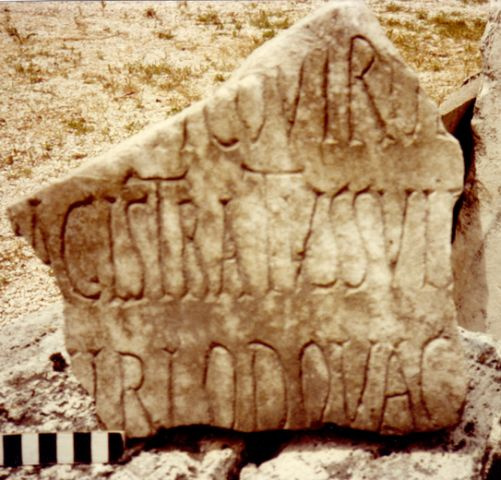
Frag. (a): ------ / [magn]ịf̣ịco viro +[---] / [--- m]agistratus sui +[---] / [---] ṿiri Odovacṛ[is ---] / ------
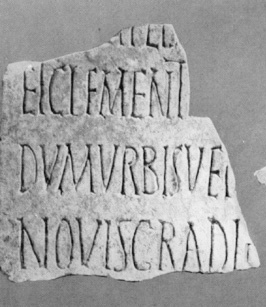
Frag. (b): ------ / [-2-3- a]ṃp̣ḷịs[sim---] / et clementi[---] / dum urbis ve+[---] / novis gradiḅ[us ---] / ------
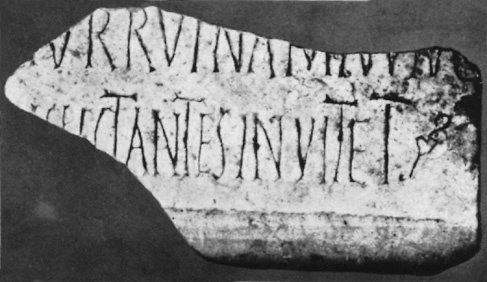
Frag. (c): ------ / [--- minaba]ṭur ruinam nunc̣ / [---i]nspectantest invitet.
Inscription translation
[The inscription is very fragmentary, but it is possible to make sense of the general meaning of the text.]
Frag. (a) To ... magnificent man, ... magistrate of his own... Odoacer…
Frag. (b): ...most excellent ...and most merciful... while of the city… new with seats…
Frag. (c): … was menaced, the ruin now … invites the spectators.
Bibliography
- Corpus Inscriptionum Latinarum; , VI, 41423
- Orlandi, S., Roma. Anfiteatri e strutture annesse con una nuova edizione e commento delle iscrizioni del Colosseo. Epigrafia anfiteatrale dell’Occidente romano 6, Rome 2004, pp. 536-539 (n. 35)
Discussion
INSCRIPTION:
The original length of the inscription is unknown. Parts of nine lines survive. Letter height 6 cm.
Frag. (a): ------ / [magn]ịf̣ịco viro +[---] / [--- m]agistratus sui +[---] / [---] ṿiri Odovacṛ[is ---] / ------
Frag. (b): ------ / [-2-3- a]ṃp̣ḷịs[sim---] / et clementi[---] / dum urbis ve+[---] / novis gradiḅ[us ---] / ------
Frag. (c): ------ / [--- minaba]ṭur ruinam nunc̣ / [---i]nspectantest invitet.
[The inscription is very fragmentary, but it is possible to make sense of the general meaning of the text.]
Frag. (a) To ... magnificent man, ... magistrate of his own... Odoacer…
Frag. (b): ...most excellent ...and most merciful... while of the city… new with seats…
Frag. (c): … was menaced, the ruin now … invites the spectators.
Our inscription records works in an unnamed structure, probably a building for public entertainment, as the reference to 'gradus' (Frag. b) and 'inspectantes' (Frag. c) suggest. However, it opens with the title 'magnificus vir' in the dative case, indicating a dedication to an imperial office-holder, probably the person responsible for the works. The hypothesis that this could be a simple building inscription recording works dedicated to an eastern emperor from the time of Odoacre should be excluded, because the rank recorded in the dative would not be used for an emperor.
DESCRIPTION (Orlandi and photograph):
Three fragments of a marble plaque: Frag. (a) 27 x 26 x 5.5 cm; Frag. (b) 31 x 31 x 4.5; Frag. (c) unknown. The fragments do not fit together. The photograph suggests that the plaque was re-used.
PROVENANCE AND LOCATION (Orlandi):
Our fragments were found during the excavation of the Ludus Magnus, as part of the landfill of room 39. It is certain that it referred to a building related to public entertainment, as the text of the inscription records. The inscription was found out of context, and therefore it might have come from the Ludus Magnus itself, or from the nearby Colosseum or even from the Circus Maximus (also near). Frags. (a) and (b) are now in the Antiquario del Celio (inv. 8316); Frag. (c) was photographed when discovered, but it was lost afterwards.
HONORAND, AWARDER AND DATE:
Our inscription records a dedication to an important office-holder, responsible for works in a building of public entertainment. the popularity of these spaces in late antique Rome (even as late as the sixth century) means that this was a very important honour. A similar (and contemporary) case might be the statues honouring Decius Marius Venantius Basilius, from the Colosseum (LSA-1419, LSA-1420 and LSA-1421), but note that there Basilius' name appears in the nominative case.
The reference to Odoacer shows that this dedication took place while he was king in Italy, between 476 and 493. Orlandi (2006, 537-538) suggests that the inscription originally also mentioned the eastern emperor (the adjective 'clementia', in Frag. (b) was usually associated with emperors) and the senate (the adjective 'amplissimus' in Frag. (b) usually refers to this institution). If this is correct, the dedication would be datable to a period of special proximity between the Ostrogothic king and the eastern court, probably between 480 and 486.
The identity of the awarder is unknown. It might have been Odoacer himself, Odoacer and the eastern emperor, or the Senate. It might also not have been mentioned in the text.
Cite: Last Statues of Antiquity, LSA-1817 (Carlos Machado).