
LSA-1818
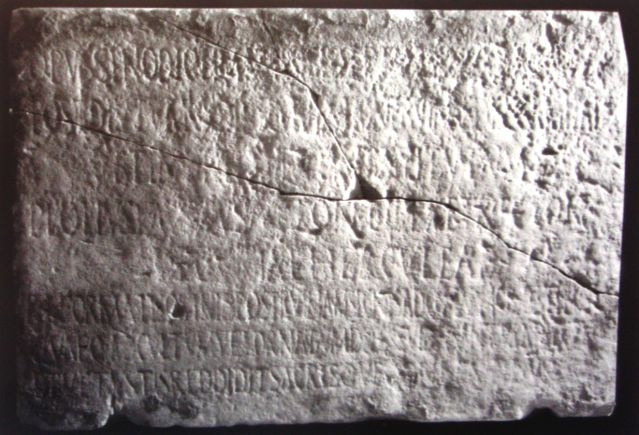
Plaque recording restoration of statues of gods by Plotius Faustus, priest. Rome. 350-400
Record details
Photographs
Textual evidence
Opus SYNODIC++++[---, quod --- conlapsum] / post diutuṛṇ(um) [aev(u)m] ṛẹṣṭịtuerụṇ[t] ++Ḍ+[---] / (vac.) et im[---]++++++ destitutum, (vac.) / Plotius F̣ạụṣṭụṣ, [v(ir) c(larissimus)], p̣ọṇṭịf̣ẹx̣ ẹṭ ṛẹc̣ṭọṛ /(5) (vac.) ḍẹcụriae Herculeae, (vac.) / reformatis omnib(us) post ruinam signis ad+[---] / quaeq(ue) ad cultum vel ornatum d[---]ṛụṇṭ [---] / et vetustis reddidit sacrisque ṃọṛịḅụṣ[---].
Translation
The work of the assembly ... which ... collapsed, after a long time they restored ... abandoned ... Plotius Faustus, of clarissimus rank, priest and leader of the company of Hercules (decuria Herculea), having restored after the ruin all the statues (signa) ... whatever things to the veneration and ornament ... and of age restored, and with sacred customs ...
Bibliography
- Di Stefano Manzella, I., "Iscrizioni latine fra età augustea ed epoca tardoantica”, in C. Frommel and M. Pentiricci (edd.), L’antica basilica di San Lorenzo in Damaso. Indagini archeologiche nel Palazzo della Cancelleria (1988-1993) (Musei Vaticani. Monumenta Sanctae Sedis 5.2), Rome 2009, pp. 32-37
Discussion
INSCRIPTION:
Parts of eight lines survive. Letter height 5-4 cm.
Opus SYNODIC++++[---, quod --- conlapsum] / post diutuṛṇ(um) [aev(u)m] ṛẹṣṭịtuerụṇ[t] ++Ḍ+[---] / (vac.) et im[---]++++++ destitutum, (vac.) / Plotius F̣ạụṣṭụṣ, [v(ir) c(larissimus)], p̣ọṇṭịf̣ẹx̣ ẹṭ ṛẹc̣ṭọṛ /(5) (vac.) ḍẹcụriae Herculeae, (vac.) / reformatis omnib(us) post ruinam signis ad+[---] / quaeq(ue) ad cultum vel ornatum d[---]ṛụṇṭ [---] / et vetustis reddidit sacrisque ṃọṛịḅụṣ[---].
'The work of the assembly ... which ... collapsed, after a long time they restored ... abandoned ... Plotius Faustus, of clarissimus rank, priest and leader of the company of Hercules (decuria Herculea), having restored after the ruin all the statues (signa) ... whatever things to the veneration and ornament ... and of age restored, and with sacred customs ...'
The inscription is fragmentary, but it is possible to understand its general meaning. Di Stefano Mazella notes that parts of the inscription were intentionally erased, but it is difficult to distinguish where this erasure ends and where natural corrosion begins. Furthermore, the inscription is not formulaic, which makes reading more difficult. The text records the restoration of an unnamed structure, and it makes reference to statues signa, presumably of Hercules.
DESCRIPTION (Di Stefano Mazella):
White marble slab, badly corroded. 61 x 90.5 x 53 cm. The slab is broken in 4 pieces, and the inscription is only partly readable. There are two marks for metal camps at lower edge.
PROVENANCE AND LOCATION:
Our inscription was discovered during excavations carried out underneath present-day church of S. Lorenzo in Damaso, next to Palazzo della Cancelleria. It is reported as being now in the Vatican Museums, but no further information is given (Di stefano Mazella).
HONORAND, AWARDER AND DATE:
The inscription refers to the restoration of an unnamed structure, including the dedication of statues. The awarder, Plotius Faustus, was a member of the senatorial order, and he is not attested anywhere else. He was a priest, rector decuriae Herculis. This priesthood is also attested to in CIL VI, 30893 (an inscribed capital of fourth century date). It is possible that the statues represented Hercules. Di Stefano Mazella dates it to the second half of the fourth century, due to content of the inscription.
Cite: Last Statues of Antiquity, LSA-1818 (Carlos Machado).