
LSA-182
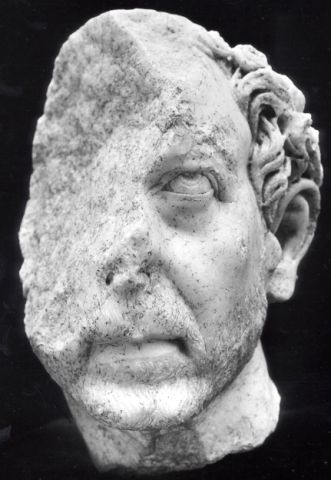
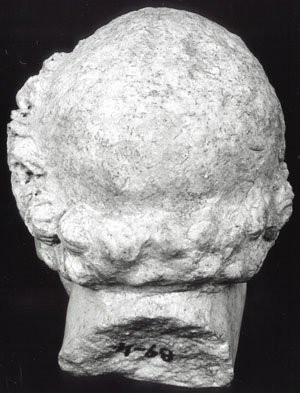
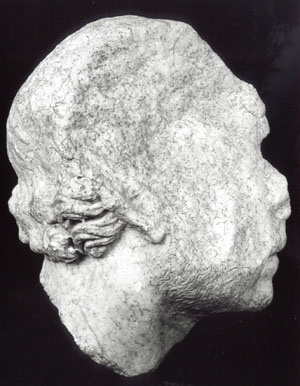
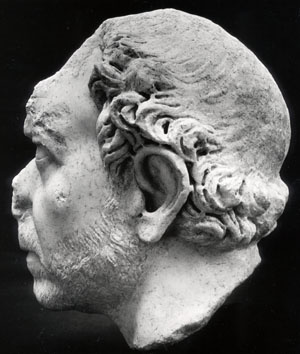
Portrait head of man with short beard and balding brow (missing right side of face). Aphrodisias (Caria). Fifth century.
Record details
Photographs
Bibliography
- Smith, R.R.R., "Statue life in the Hadrianic Baths at Aphrodisias, AD 100-600: Local context and historical meaning", in F.A. Bauer, C. Witschel (eds.), Statuen und Statuensammlungen in der Spätantike - Funktion und Kontext (Spätantike, Frühes Christentum, Byzanz: Kunst im ersten Jahrtausend), Wiesbaden 2007, 229, no. A 45
- Smith, R.R.R. 'Late antique portraits in a public context: Honorific statuary at Aphrodisias in Caria, AD 300-600' , Journal of Roman Studies, 89 (1999), 155-89, 184, pl. 8.3-4
- Smith, R.R.R. and J. Lenaghan (eds.), Aphrodisias'tan Roma portreleri = Roman portraits from Aphrodisias
, Istanbul 2008, no. 31
Discussion
DESCRIPTION (Object)
Over life-size portrait head. H: 26 cm, W: 17 cm, D: 19 cm. White marble.
The head is broken through neck, and the proper right side of head has broken off.
The hair at the top of the head is worked with a flat chisel. The hair around the face, the ‘wreath’, is deeply drilled, and bridges of marble have been left over some of the channels. The facial hair is finely engraved. The extant eye has an engraved iris that does not touch the lower lid and a deeply carved pupil.
PROVENANCE
Found in 1989 at the western end of the pool in the South Agora. It was found with several other heads (for example, LSA-168, LSA-173, LSA-184) and probably belonged to a statue set up in west portico of the South Agora or forecourt to the Hadrianic Baths.
DESCRIPTION (Subject)
The head turns to its left and has an animated appearance. The portrait shows a man with pronounced individual features and a distinctive personal style.
The physiognomy is marked by a sloping brow, small eyes, modeled skin under the eyes, a prominent nose, deep naso-labial folds, and a receding chin. The corners of the mouth are tucked into the fleshier cheeks, and the upper lip has an angular central overhang. The large balding brow is bordered by a thick wreath of loosely curling hair, and on his cheeks and chin are a finely incised beard and moustache.
DATE AND HONORAND
The hairstyle and technical details date the portrait to the fifth century AD, when the Aphrodisian workshops continued to make high-quality marble statues with undiminished mastery (see LSA-169, LSA-170, LSA-174, LSA-181). Those most frequently honored in this period were the Roman governors sent to Aphrodisias, now a provincial capital, from the imperial centre at Constantinople. Their portraits are characterized by austere expressions and an intense gaze, which was the result of the technically emphatic rendering of the eyes.
Cite: Last Statues of Antiquity, LSA-182 (J. Lenaghan).