
LSA-1820
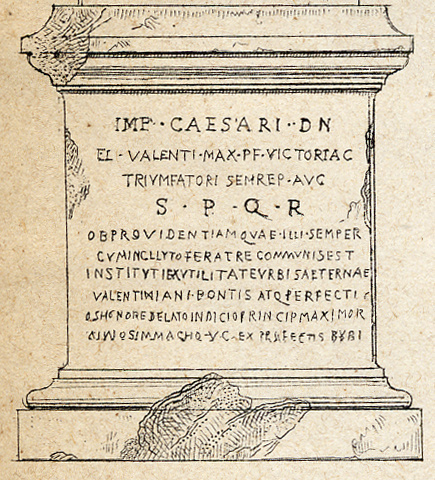
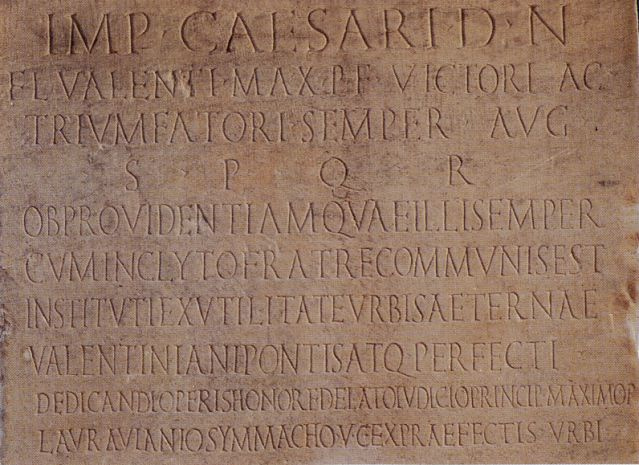
Base for statue of Valens. Rome (Pons Valentiniani). 366-367.
Record details
Photographs

Inscription
Imp(eratori) Caesari d(omino) n(ostro)/ Fl(avio) Valenti max(imo) p(io) f(elici) victori ac/ triumfatori semper Aug(usto) S(enatus) P(opulus)q(ue) R(omanus)/5 ob providentiam quae illi semper/ cum inclyto fratre communis est/ instituti ex utilitate Urbis aeternae/ Valentiniani pontis atq(ue) perfecti/ dedicandi operis honore delato iudicio princip(um) maximor(um)/10 L(ucio) Aur(elio) Avianio Symmacho v(iro) c(larissimo) ex praefectis urbi.
Inscription translation
For the emperor Caesar, our lord, Fl(avius) Valens, the greatest, pious, fortunate, victor, and forever triumphant Augustus. The Senate and Roman People (set this up) on account of the providence--which is always common to that man and his famous brother--of undertaking and finishing the bridge of Valentinian for the use of the eternal city. The honour of dedicating the work was granted by the decision of the greatest princes to Lucius Aurelius Avianius Symmachus, a man of clarissimus rank, a former prefect of the city.
Bibliography
- Corpus Inscriptionum Latinarum; , VI 31402
- Ensoli, S. and E. La Rocca (eds.), Aurea Roma: dalla città pagana alla città cristiana, Roma 2000, 460-461, no. 61
- Lanciani, R. 'XII. Monumenti rinvenuti nell'alveo del Tevere sotto il ponte sisto', Bullettino della commissione archeologica comunale di Roma 6, Rome 1878, 245-8, no. 114, pls. 20-21
Discussion
PROVENANCE
Found on the banks of the Tiber near the Ponte Sisto in 1878.
CONTEXT
In 1878 in an attempt to make the Tiber flow more smoothly, ancient blocks around the Ponte Sisto on the Campus Martius side were isolated and removed. This project revealed various building blocks and statuary fragments. Among these were an imperial portrait head of the fourth century in gilded bronze (LSA-580), a togate statue also in gilded bronze and generally considered high imperial in date but re-used with the head (LSA-1072), and a base with an inscription for Valens (LSA-1820). The bronze feet of the statue were found set with lead into a block which had a rough moulding.
The inscription of the base unmistakeably follows the formula of statuary. The Emperor and his titles appear first in the dative. Then the donating body the Senate and People of Rome are in the nominative and set on their own line. The reason for the honour (ob= because) is explained immediately thereafter. Then the man (the well-known L. Aurelius Avianius Symmachus signo Phosphorius, PLRE I, Symmachus 3, pp. 863-5), who oversaw the actual setting up of the honour is listed. Two bases for Victories (LSA-2584 and LSA-2585) were also found and featured the same dedicatory formula with the same honorific body and overseer; one of these was surely bronze (LSA-2586). Those bases are usually thought to have fit within the parapet or balustrade of the bridge.
The block inscribed for Valens, however, is unusually broad and deep for a statue base and seems to have been part of an architectural setting. It is worked fully on three sides and not at the back. The lateral mouldings, Lanciani writes, continued on another element.
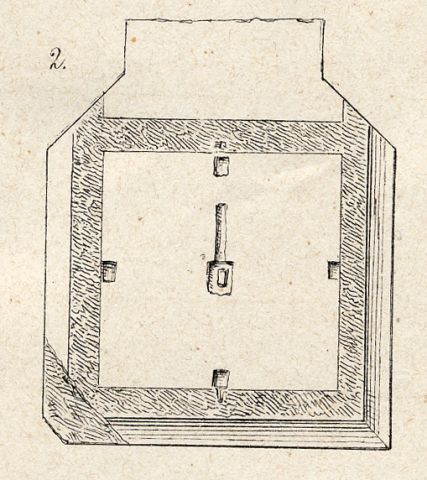
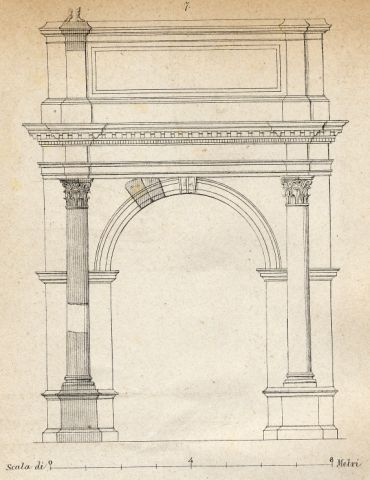
The upper surface of the base featured cuttings which Lanciani believed corresponded to similar cuttings on the base of a column found nearby. His drawing of the upper surface of the inscribed base shows a lewis hole (which is not centrally located but towards the back) and then a central dowel hole and four rectangular cuttings at the centre of each side. That column base moreover corresponds, again according to Lanciani, perfectly in size to a broken shaft of a purplish granite, again found nearby, which had a dowel that connected it to a capital, also found. He reconstructed this as a disengaged column on the façade of an arch, an arch because he also had found two voussoir fragments of a large vault. He placed the statue on the basis of the block into which the feet were set on the attic of the arch. He believed that the projecting moulding of the block with the feet corresponded to the projection over the disengaged column on the façade. He noted that both the cunei and the statue were earlier in date than the fourth century and were probably re-used in this opus of 364-367.
It seems possible that the moulded block, onto which the bronze feet of the statue were set, belongs directly above a Corinthian column capital rather than above a projecting entablature of the attic of an arch. The block is moulded on three sides but really lacks any decorative elements of an architectural entablature (see LSA-1072, drawing by Lanciani, and description by G. Fiorello, Notizie degli Scavi, 1878, p. 344, as cimasa profilata per tre lati). The monument might, as the statues of Victories (LSA-2584, LSA-2585, and LSA-2586), be better understood in light of the fragments of the fourth century balustrade than with the two voussoir blocks of the high imperial period. For example, one might imagine a column monument of the Emperor attached to the balustrade of the bridge, preferably at its end.
DATE
The base makes mention of Valens and his brother Valentinian without reference to Gratian. No element from the context of the bridge mentions Gratian. Thus, it should date before Gratian’s elevation to Augustus. The overseer of the project is L. Aurelius Avianius Symmachus signo Phosphorius who is referred to as ex prefect of the city. He was prefect of the city in 364-365. Thus, the base was erected after 365 and before 367.
Discussion references
- Coarelli, F. 'Pons Agrippae, Pons Aurelius, Pons Valentiniani', Lexicon Topographicum Urbis Romae. VI, P-S, Rome 1999, 107-108 (accepts Lanciani)
Cite: Last Statues of Antiquity, LSA-1820 (J. Lenaghan).