
LSA-1821
Base for statue of Constantius I, emperor. From Abbir Maius (Africa Proconsularis). 305-306
Record details
Photographs
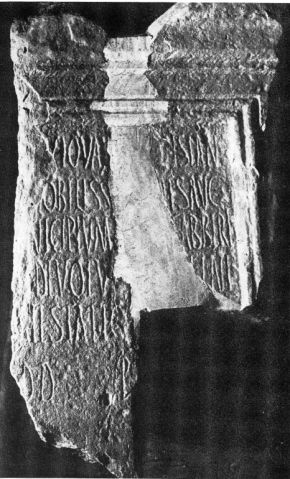
Inscription
[M(arco) Fla]vio Vale[rio Co]nstan/[tio], nobilissi[mo C]aes(ari), Aug(usto), / [mu]nicipium A[ur(elium) An]t(oninianum) Abbirit(anum) / [Mai(us)], devotum [nu]mini / [m]aiestatiqu[e eius], / d(ecreto) d(ecurionum), p(ecunia) p(ublica).
Inscription translation
To Marcus Flavius Valerius Constantius, most noble Caesar, Augustus; the Aurelian Antoninian city (municipium Aurelium Antoninianum) of Abbir Maius, devoted to his divine spirit and majesty, [set this up] by decree of the councillors, with public funds.
Bibliography
- Ben Abdallah, Z. B., Catalogue des inscriptions latines païenne du Musée du Bardo, Rome 1986, no. 371
- Lepelley, C., Les cités de l'Afrique romaine au Bas-Empire, t. 2, Notices d'histoire municipale, Paris 1981, p. 53, n. 1
Discussion
INSCRIPTION
In six lines:
[M(arco) Fla]vio Vale[rio Co]nstan/[tio], nobilissi[mo C]aes(ari), Aug(usto), / [mu]nicipium A[ur(elium) An]t(oninianum) Abbirit(anum) / [Mai(us)], devotum [nu]mini / [m]aiestatiqu[e eius], / d(ecreto) d(ecurionum), p(ecunia) p(ublica).
'To Marcus Flavius Valerius Constantius, most noble Caesar, Augustus; the Aurelian Antoninian city (municipium Aurelium Antoninianum) of Abbir Maius, devoted to his divine spirit and majesty, [set this up] by decree of the councillors, with public funds.'
Letter height : 5 cm
The reading offered here is that of Pflaum, 1970, p. 120.
The designation of the municipium of Abbir Maius as 'Aurelium Antoninianum' is because it was given municipal status by the emperor Caracalla (full name, Marcus Aurelius Severus Antoninus, 211-17).
DESCRIPTION (from ILPB, L. Poinssot and the published photo)
Limestone base with moulding at top, of which two pieces survive: missing are the whole of the bottom and centre of the block, and its lower right side. H 88, W 46, D 51 cm. The inscription, which is badly damaged, is framed by a moulding.
PROVENANCE AND CURRENT LOCATION
The base was found in April 1910 by Poinssot. Its precise find-spot is unrecorded. It is now into the storerooms of the Bardo Museum (Inv. D 1225).
HONORAND, AWARDER AND DATE
The honorand, Constantius I, was Caesar from 293 to 305 and Augustus from 305 until his death in 306. Our base dates from his rule as Augustus, and may well have been set up to honour his elevation.
The awarder was the city, as usual with imperial statues in Africa.
Discussion references
- Compte-rendus des séances de la Commission de l'Afrique du Nord, Bulletin archéologique du Comité des Travaux Historiques et Scientifiques, Paris, p. 303-305
- Pflaum, H.-G., 'La Romanisation de l'ancien territoire de Carthage punique à la lumière des découvertes épigraphiques récentes', Antiquités africaines, IV, Paris, 1970, p. 120, n. 2
Cite: Last Statues of Antiquity, LSA-1821 (Gabriel de Bruyn).