
LSA-1822
Base for statue of Constantius Gallus, emperor. Abitinae (Africa Proconsularis). 353-354
Record details
Photographs
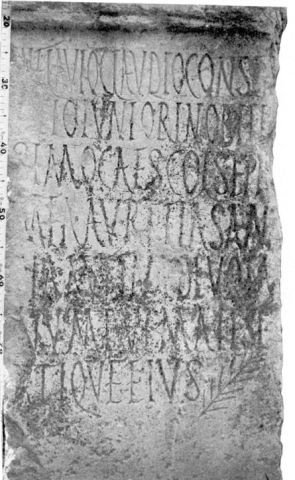
Inscription
[D(omino)] n(ostro) Flavio Claudio Consta/[n]tio iuniori, nobili[s]/simo Caes(ari), col(onia) Septi/mia Aurelia san/cta Avitina, devota / numini maiest/atique eius.
Inscription translation
To our lord Flavius Claudius Constantius the younger, most noble Caesar; the blessed Septimian Aurelian colony of Abitina, devoted to his divine spirit and majesty, [set this up].
Bibliography
- L'Année épigraphique, Paris, 1976, no. 704
- Lepelley, C., Les cités de l'Afrique romaine au Bas-Empire, t. 2, Notices d'histoire municipale, Paris 1981, p. 57, n. 6
Discussion
INSCRIPTION
In seven lines:
[D(omino)] n(ostro) Flavio Claudio Consta/[n]tio iuniori, nobili[s]/simo Caes(ari), col(onia) Septi/mia Aurelia san/cta Avitina, devota / numini maiest/atique eius.
'To our lord Flavius Claudius Constantius the younger, most noble Caesar; the blessed Septimian Aurelian colony of Abitina, devoted to his divine spirit and majesty, [set this up].'
Letter height (from the photograph) : 5 - 6 cm.
DESCRIPTION (from A. Beschaouch)
Beschaouch records it as a base, but gives no description, only a photograph. From this, we can see that it has an upper moulding, and is about 100 cm high and 35 cm wide.
PROVENANCE AND CURRENT LOCATION
First published in 1976 by Beschaouch, who found it in the ancient ruins of Chouhoud el-Batin ('inscription inédite de Chouhoud el-Batin'). There is no recent published record of its location.
HONORAND, AWARDER AND DATE
The honorand, 'Flavius Claudius Constantius' (always referred to by modern scholarship as 'Constantius Gallus'), was Caesar from 351 to 354.
The awarder was the city, as usual with imperial statues in Africa. The designation of Abitinae as 'colonia Septimia Aurelia' is because it was given colonial status under Septimius Severus and Caracalla (198-211).
Our base must postdate the fall of the usurper Magnentius in 353, since Magnentius controlled Africa and did not recognise the legitimacy of Gallus.
FURTHER DISCUSSION
Since Gallus was a junior emperor, it is very likely that our base was originally accompanied by a second base, to the Augustus Constantius II.
Discussion references
- Comptes-rendus de l'Académie des Inscriptions et Belles-Lettres, Paris, 1976, p. 264, fig. 6
Cite: Last Statues of Antiquity, LSA-1822 (Gabriel de Bruyn).