
LSA-1823
Base for statue of Valentinian I, emperor. Furnos Minus (Africa Proconsularis). 366-367
Record details
Photographs
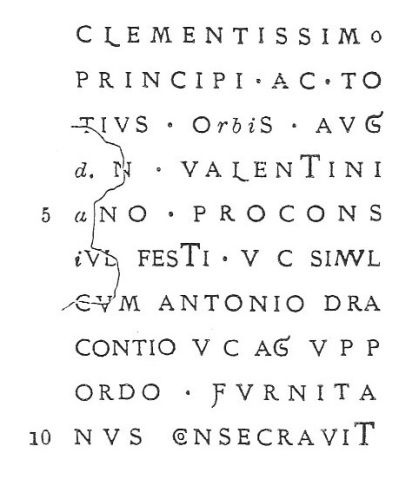
Inscription
Clementissimo / principi, ac to/tius or[bi]s Aug(usto), / [d(omino)] n(ostro) Valentini/[a]no, procons(ulatu) / (6) [I]ul(i) Festi, v(iri) c(larissimi), simul / cum Antonio Dra/contio, v(iro) c(larissimo), ag(ente) v(ices) p(raefectorum) p(raetorio), / ordo Furnita/nus consecravit.
Inscription translation
To the most merciful ruler, and Augustus of the whole world, our lord Valentinianus; under the governorship of Iulius Festus, of clarissimus rank, along with Antonius Dracontius, [also] of clarissimus rank, serving as praetorian prefect, the council (ordo) of Furnos consecrated [this].
Bibliography
- Corpus Inscriptionum Latinarum; , VIII, no. 14752
- Lepelley, C., Les cités de l'Afrique romaine au Bas-Empire, t. 2, Notices d'histoire municipale, Paris 1981, p. 113, n. 4
Discussion
INSCRIPTION
In ten lines:
Clementissimo / principi, ac to/tius or[bi]s Aug(usto), / [d(omino)] n(ostro) Valentini/[a]no, procons(ulatu) / (6) [I]ul(i) Festi, v(iri) c(larissimi), simul / cum Antonio Dra/contio, v(iro) c(larissimo), ag(ente) v(ices) p(raefectorum) p(raetorio), / ordo Furnita/nus consecravit.
'To the most merciful ruler, and Augustus of the whole world, our lord Valentinianus; under the governorship of Iulius Festus, of clarissimus rank, along with Antonius Dracontius, [also] of clarissimus rank, serving as praetorian prefect, the council (ordo) of Furnos consecrated [this].'
Letter height : 5.5 cm
DESCRIPTION (from R. Cagnat)
Of this base Cagnat gives no description, other than its measurements: H 100, W 41 cm, depth unrecorded.
PROVENANCE AND CURRENT LOCATION
There is no published record of its precise find-spot or present location.
HONORAND, AWARDER AND DATE
The honorand, Valentinian I, was Augustus from 364 to 375.
The awarder was the city, as usual with imperial statues in Africa.
The inscriptions is dated by the governorship of Iulius Festus Hymetius, 366-8 (PLRE I, 447 Hymetius), and by the vicariate of Africa of Antonius Dracontius, 364-7 (PLRE I, 271 Dracontius 3). Our base must therefore have been dedicated between 366 and 367.
FURTHER DISCUSSION
This is a good example of a common late antique phenomenon. Although the statue is set up by a city, the council names (and thereby commemorates) not any civic officials, but two imperial officers, the governor (proconsul) and the vicarius of Africa.
Discussion references
- Cagnat, R., Archives des missions scientifiques et littéraires, Paris, 1882, t. IX, p. 65, no. 6
Cite: Last Statues of Antiquity, LSA-1823 (Gabriel de Bruyn).