
LSA-1826
Base for statue of Maximian, emperor. Ammaedara (Africa Proconsularis). 286-305
Record details
Photographs
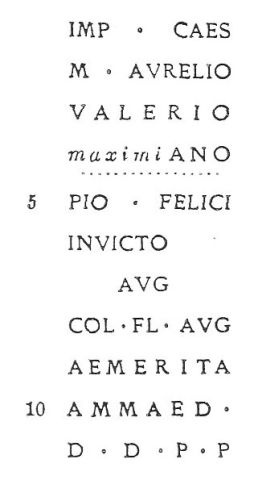
Inscription
Imp(eratori) Caes(ari) / M(arco) Aurelio / Valerio / [[[Maximi]ano]], / pio, felici, / invicto / Aug(usto), / col(onia) Fl(avia) Aug(usta) / aemerita (sic) Ammaed(ara), / d(ecreto) d(ecurionum), p(ecunia) p(ublica).
Inscription translation
To the emperor Caesar Marcus Aurelius Valerius Maximianus, pious, fortunate, invincible Augustus, the Flavian imperial veterans' colony of Ammaedara [set this up] by decree of the councillors, with public funds.
Bibliography
- Corpus Inscriptionum Latinarum; , VIII, no. 308
Discussion
INSCRIPTION
In ten lines:
Imp(eratori) Caes(ari) / M(arco) Aurelio / Valerio / [[[Maximi]ano]], / (5) pio, felici, / invicto / Aug(usto), / col(onia) Fl(avia) Aug(usta) / Aemerita (sic) Ammaed(ara), / d(ecreto) d(ecurionum), p(ecunia) p(ublica).
'To the emperor Caesar Marcus Aurelius Valerius Maximianus, pious, fortunate, unconquered Augustus; the Flavian imperial veterans' colony of Ammaedara [set this up] by decree of the councillors, with public funds.'
Letter height : 5 cm
The principal name of the honorand, Maximian, has been deliberately erased.
DESCRIPTION (from CIL)
CIL gives no description of the base, other than its measurements: H 110, W 50 cm, depth unrecorded.
PROVENANCE AND CURRENT LOCATION
Found re-used in the walls of the Byzantine fortress, where it remains.
HONORAND, AWARDER AND DATE
The honorand, Maximian, was Augustus from 286 to 305 and again from 306 to 310.
The awarder was the city, as usual with imperial statues in Africa. The colony of Ammaedara was founded in the later 1st century A.D. by one of the emperors of the Flavian dynasty, specifically for veteran soldiers; hence its designation as 'Flavia Augusta' and 'Emerita'.
Maximian's rule was highly contested after 305 and Africa was under the control of Domitius Alexander between 308 and 309. Therefore, this base must date from the period of the first Tetrarchy, 286-305.
FURTHER DISCUSSION
It is not certain when Maximian's name was erased. It is possible that it happened between 310 and 312, during the reign of his son Maxentius, after Maximian had revolted against him. But it is perhaps more likely that it was removed at an unknown date by Christians who remembered his activities as a persecutor, since at Lambaesis, both Maximian's and Diocletian's names were removed from inscriptions (LSA-2258, LSA-2255). Diocletian was of course a notorious persecutor, but never fell from political favour.
Cite: Last Statues of Antiquity, LSA-1826 (Gabriel de Bruyn).