
LSA-1828
Base for statue of Valens, emperor. Apisa Maius (Africa Proconsularis). 364-375
Record details
Photographs
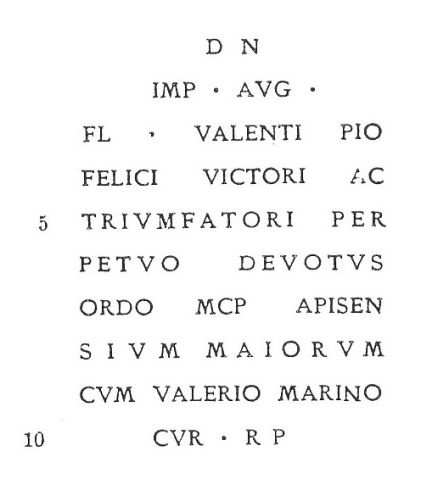
Inscription
D(omino) n(ostro), / imp(eratori) Aug(usto) / Fl(avio) Valenti, pio, / felici victori, ac / (5) triumfatori per/petuo, devotus / ordo m(uni)c(i)p(ii) Apisen/sium Maiorum, / cum Valerio Marino / cur(atore) r(ei) p(ublicae).
Inscription translation
To our lord, the emperor Augustus Flavius Valens, pious [and] fortunate victor, and always triumphant; the devoted council of the city (ordo municipii) of Apisa Maius [set this up], with Valerius Marinus, curator of the city.
Bibliography
- Corpus Inscriptionum Latinarum; , VIII, no. 780
- Lepelley, C., Les cités de l'Afrique romaine au Bas-Empire, t. 2, Notices d'histoire municipale, Paris 1981, p. 70, n. 10
Discussion
INSCRIPTION
In ten lines:
D(omino) n(ostro), / imp(eratori) Aug(usto) / Fl(avio) Valenti, pio, / felici victori, ac / (5) triumfatori per/petuo, devotus / ordo m(uni)c(i)p(ii) Apisen/sium Maiorum, / cum Valerio Marino / cur(atore) r(ei) p(ublicae).
'To our lord, the emperor Augustus Flavius Valens, pious [and] fortunate victor, and always triumphant; the devoted council of the city (ordo municipii) of Apisa Maius [set this up], with Valerius Marinus, curator of the city.'
Letter height : 4 cm
DESCRIPTION (from CIL)
CIL gives no description of this base, other than its measurements: H 118, W 50 cm, depth unrecorded.
PROVENANCE AND CURRENT LOCATION
There is no published record of its precise find-spot or present location.
HONORAND, AWARDER AND DATE
The honorand, Valens, was Augustus (in the East) from 364 to 378.
The awarder was the city, as usual for imperial statues in Africa. Its curator, Valerius Marinus, is known only from this inscription and its pair (LSA-1827).
Our statue must have been dedicated at the same time as that to the western Augustus, Valentinian I (LSA-1827), since they are very similar and both associated with the same curator of Apisa Maius. Since Valentinian died in 375, our base can therefore be dated between 364 and 375.
Cite: Last Statues of Antiquity, LSA-1828 (Gabriel de Bruyn).