
LSA-1829
Base for statue of Constantine I, emperor. Asadi (Africa Proconsularis). 312-324.
Record details
Photographs
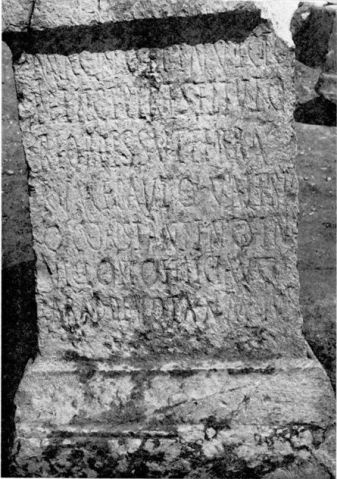
Inscription
Magno et invicto / principi, restituto/ri orbis sui terra/rum, Flavio Valeri/o Constantino, in/victo, pio, felici Aug(usto), Asadi, devota n(umini) m(aiestatique) eius.
Inscription translation
To the great and unconquered ruler, restorer of his world, Flavius Valerius Constantinus, unconquered, pious, fortunate Augustus; Asadi, devoted to his divine spirit and majesty, [set this up].
Bibliography
- L'Année épigraphique, Paris, 1974, no 693
- Lepelley, C., Les cités de l'Afrique romaine au Bas-Empire, t. 2, Notices d'histoire municipale, Paris 1981, p. 73, n. 3
Discussion
INSCRIPTION
In six lines:
Magno et invicto / principi, restituto/ri orbis sui terra/rum, Flavio Valeri/o Constantino, in/victo, pio, felici Aug(usto), Asadi, devota n(umini) m(aiestatique) eius.
'To the great and unconquered ruler, restorer of his world, Flavius Valerius Constantinus, unconquered, pious, fortunate Augustus; Asadi, devoted to his divine spirit and majesty, [set this up].'
Letter height : 6 - 7 cm
DESCRIPTION (from A. Beschaouch and the published photograph)
Base with plinth and crown, broken at the top right corner: H 124, W 75, D 42 cm. Beschaouch states that the poor quality of the stone and carving makes the reading difficult ('la mauvaise qualité de la pierre et de la gravure rend la lecture malaisée').
PROVENANCE AND CURRENT LOCATION
There is no published record of its precise find-spot or present location.
HONORAND, AWARDER AND DATE
The honorand, Constantine, was Augustus from 307 to 337.
The awarder was the city, as usual for imperial statues in Africa.
The grandiose formula restitutor orbis sui terrarum (literally, 'restorer of his orb of the earth') almost certainly excludes the first years of Constantine's reign for our dedication, even though Domitius Alexander, usurper in Africa in 308-10, did attempt good relations with Constantine. The period 310-12 is also excluded, since Africa was then under the control of Maxentius, whose relations with Constantine were poor, following the death of Maximian. In 324 Constantine replaced invictus, which appears on our base but has pagan connotations, with victor (Lassère 2005, 607). Our base is therefore almost certainly of the period between 312 and 324.
Beschaouch argues that the absence of the title 'Maximus, the greatest', granted to Constantine in 312 by the Senate (after his victory at the Milvian Bridge), provides a terminus ante quem, and Ehrhard even suggests that the base can be precisely dated to the end of 312 - after news of Constantine's victory over Maxentius had reached Asadi, but before news had arrived of the granting of the title of 'Maximus' (Ehrhard 1980). If so, the statue would be a rushed commission by the city of Asadi, to honour the new master of Africa. However, the absence of 'Maximus' is not a hard and fast dating criterion, since several dedications to Constantine that can be dated to after 312 omit it (see Lepelley, 1981, and, for example, LSA-1894).
Discussion references
- Beschaouch, A., "La découverte de trois cités en Afrique proconsulaire (Tunisie) : Alma, Vrev et Asadi. Une contribution à l'étude de la politique municipale de l'Empire romain", Comptes-rendus de l'Académie des Inscriptions et Belles-lettres, Paris, 1974, p. 228-31, fig. 5
- Ehrhardt, C. T. H. R., '"Maximus", "invictus" und "victor" als Datierungskriterien auf Inschriften Konstantins des Grossen ', Zeitschrift für Papyrologie und Epigraphik 38, Bonn 1980, p. 177-180
- Lassère, J.-M., Manuel d'épigraphie romaine, Paris, 2005, p. 607
Cite: Last Statues of Antiquity, LSA-1829 (Gabriel de Bruyn).