
LSA-183
Inscribed base for Eupeithius (posthumous). Aphrodisias (Caria). Fourth century.
Record details
Photographs
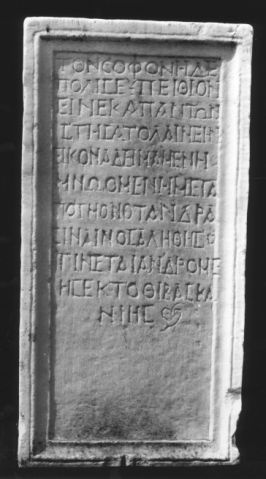
Inscription
τὸν σοφὸν ἥδε / πόλις Εὐπείθιον / εἵνεκα πάντων / στήσατο λαϊνέην / (5) εἰκόνα δειμαμένη leaf / μνωομένη μετὰ / πότμον ὅτ' ἀνδρά/ σιν αἶνος / ἀληθὴς leaf / τίνεται ἀνδρομέ/ (10)ης ἔκτοθι βασκα/νίης leaf
Inscription translation
This city had made and set up a stone image (of) the wise Eupeithius because of everything, recalling that it is after death that true praise, beyond human envy, is accorded to men.
(Trans. C. Roueché)
Bibliography
- Roueché, C., Aphrodisias in Late Antiquity (Journal of Roman Studies Monograph 5), London 1989, no. 33
Discussion
INSCRIPTION
Verse inscription of two elegiac distichs laid out in eleven lines:
τὸν σοφὸν ἥδε / πόλις Εὐπείθιον / εἵνεκα πάντων /
στήσατο λαϊνέην / (5) εἰκόνα δειμαμένη leaf /
μνωομένη μετὰ / πότμον ὅτ' ἀνδρά/ σιν αἶνος / ἀληθὴς leaf /
(9) τίνεται ἀνδρομέ/ης ἔκτοθι βασκα/νίης leaf
'This city had made and set up a stone image (of) the wise Eupeithius because of everything, recalling that it is after death that true praise, beyond human envy, is accorded to men.'
(Trans. C. Roueché)
Letter height 3 - 4.5 cm.
DESCRIPTION
Inscribed shaft: H: 97, W: 48.5, D: 38 m. Lower plinth H: 20.5, W: 78, D: 67 m. Upper plinth H: 25, W: 75 , D: 67.5 cm. White marble.
The base was composed of three separate elements: (1) a moulded upper plinth bearing the inscription agathē tychē (heart); (2) an inscribed, re-used rectangular shaft; (3) a lower moulded plinth.
PROVENANCE
Several pieces probably from the same statue monument were excavated in the northern sector of the Hadrianic Baths. An upper plinth, lower plinth, and statue fragment were all found in the same room.
HONORAND AND DATE
Although vague as to the occupation of honorand and the precise reasons for the honour, the verse does contain some clues. The name, 'the good persuader', the epithet 'sophos', and the fact that the honour is posthumous suggest that the honorand was a cultural figure, possibly a philosopher or teacher, rather than an office-holder. The lettering and wording are dated to the mid to late fourth century.
Discussion references
- Smith, R.R.R., "Statue life in the Hadrianic Baths at Aphrodisias, AD 100-600: Local context and historical meaning", in F.A. Bauer, C. Witschel (eds.), Statuen und Statuensammlungen in der Spätantike - Funktion und Kontext (Spätantike, Frühes Christentum, Byzanz: Kunst im ersten Jahrtausend), Wiesbaden 2007, 230, no. B 36
Cite: Last Statues of Antiquity, LSA-183 (J. Lenaghan).