
LSA-1830
Base for statue of Gratian, emperor. Aulodes (Africa Proconsularis). 367-383
Record details
Photographs
Inscription
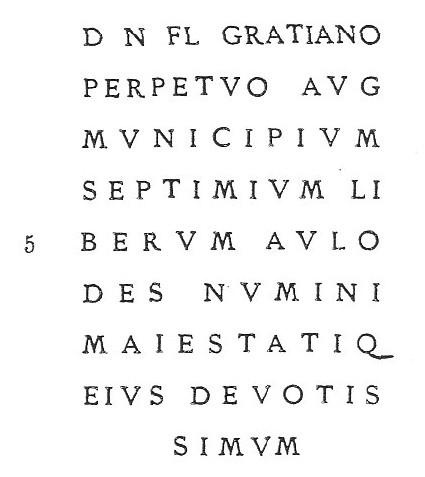
D(omino) n(ostro) Fl(avio) Gratiano, / perpetuo Aug(usto), / municipium / (4) Septimium li/berum Aulo/des, numini / maiestatiq(ue) / eius devotis/simum.
Inscription translation
To our lord Flavius Gratianus, eternal Augustus; the Septimian free city (municipium Septimium liberum) of Aulodes, most devoted to his divine spirit and majesty, [set this up].
Bibliography
- Corpus Inscriptionum Latinarum; , VIII, no. 14355
- Lepelley, C., Les cités de l'Afrique romaine au Bas-Empire, t. 2, Notices d'histoire municipale, Paris 1981, p. 75, n. 1
Discussion
INSCRIPTION
In eight lines:
D(omino) n(ostro) Fl(avio) Gratiano, / perpetuo Aug(usto), / municipium / (4) Septimium li/berum Aulo/des, numini / maiestatiq(ue) / eius devotis/simum.
'To our lord Flavius Gratianus, eternal Augustus; the Septimian free city (municipium Septimium liberum) of Aulodes, most devoted to his divine spirit and majesty, [set this up].'
Letter height : 5 cm
DESCRIPTION (from R. Cagnat and S. Reinach)
Our base was re-used, adapted from an earlier tombstone (CIL VIII 14356): H 67, W 36 cm, depth unrecorded. Cagnat and Reinach, noting fixing holes in its upper part ('trous de scellement qui se remarquent encore à la partie supérieure'), identified its function in the period of Gratian as a statue base, an identification which is also supported by the formula of the inscription.
PROVENANCE AND CURRENT LOCATION
Found in 1884-5, re-used in the southeast corner of the sacred precincts of the Muslim period qubba. There is no recent published record of its location, but it may well still be there.
HONORAND, AWARDER AND DATE
The honorand, Gratian, was Augustus from 367 to 383.
The awarder was the city, as usual for imperial statues in Africa. Aulodes is described as 'Septimian' because it was raised to the status of a municipium under the emperor Septimius Severus (probably between 193 and 198). The precise meaning of its designation as 'free (liberum)' is uncertain (see Lepelley 1981, 75-6).
Discussion references
- Comptes-rendus de l'Académie des Inscriptions et Belles-Lettres, Paris, 1885, p. 256
- Compte-rendus des séances de la Commission de l'Afrique du Nord, Bulletin archéologique du Comité des Travaux Historiques et Scientifiques, Paris, 1886, p. 108
Cite: Last Statues of Antiquity, LSA-1830 (Gabriel de Bruyn).