
LSA-1833
Base for statue of Licinius, emperor. From Bisica Lucana (Africa Proconsularis). 318
Record details
Photographs
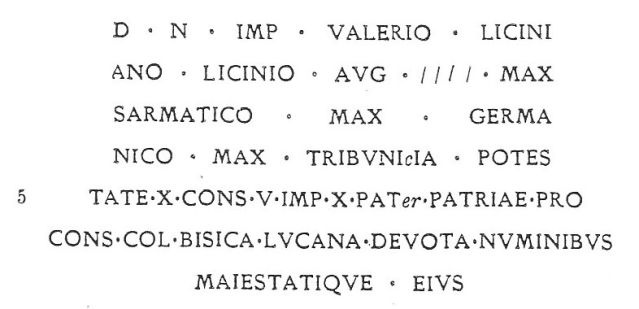
Inscription
D(omino) n(ostro) imp(eratori) Valerio Licini/ano Licinio, Aug(usto), [pontifici] max(imo), / Sarmatico max(imo), Germa/nico max(imo), tribuni[c]ia potes/tate X, cons(uli) V, imp(eratori) X, pat(ri) patriae, pro/cons(uli), col(onia) Bisica Lucana, devota numinibus / maiestatique eius.
Inscription translation
To our lord, the emperor Valerius Licinianus Licinius, Augustus, highest priest, greatest victor over the Sarmatians, greatest victor over the Germans, holding tribunician power ten times, consul five times, acclaimed victor (imperator) ten times, father of the fatherland, proconsul. The colony of Bisica Lucana, devoted to his divine spirits and majesty, [set this up].
Bibliography
- Corpus Inscriptionum Latinarum; , VIII, no. 1357
Discussion
INSCRIPTION
In seven lines:
D(omino) n(ostro) imp(eratori) Valerio Licini/ano Licinio, Aug(usto), [pontifici] max(imo), / Sarmatico max(imo), Germa/nico max(imo), tribuni[c]ia potes/tate X, cons(uli) V, imp(eratori) X, pat(ri) patriae, pro/cons(uli), col(onia) Bisica Lucana, devota numinibus / maiestatique eius.
'To our lord, the emperor Valerius Licinianus Licinius, Augustus, highest priest, greatest victor over the Sarmatians, greatest victor over the Germans, holding tribunician power ten times, consul five times, acclaimed victor (imperator) ten times, father of the fatherland, proconsul. The colony of Bisica Lucana, devoted to his divine spirits and majesty, [set this up].'
DESCRIPTION
There are no published descriptions or measurements of this base, and no published image.
PROVENANCE AND CURRENT LOCATION
The base was found in the market of the modern city of Testour in the 18th century. J.-A. Peyssonel saw and recorded it there in 1724-5. Testour is located a few kilometres north of Bisica Lucana (Hr. Bijga), from which it presumably came. The base was last recorded by L. Poinssot in 1938-40.
HONORAND, AWARDER AND DATE
The honorand, Licinius, was Augustus from 308 to 324.
The awarder was the city, as usual for imperial statues in Africa.
Licinius' tenth holding of tribunician power (tribunicia potestas) is normally dated between 10 December 316 and 9 December 317; however his fifth consulship and his tenth proclamation as 'Imperator' occurred in 318. Either the inscription is at fault, or Licinius' tenth tribunicia potestas should correctly be dated to between December 317 and December 318, as suggested by Jean Lafaurie (Lafaurie 1965, 203), and agreed with by C. Lepelley (Lepelley 1981, 85-6, n. 7).
Discussion references
- Compte-rendus des séances de la Commission de l'Afrique du Nord, Bulletin archéologique du Comité des Travaux Historiques et Scientifiques, Paris, 1938-1940, p. 242, n°3
- Lafaurie, J., "Remarques sur les dates de quelques inscriptions du début du IVe siècle", Comptes-rendus des séances de l'Académie des inscriptions et belles-lettres, Paris, 1965, p. 203
- Lepelley, C., Les cités de l'Afrique romaine au Bas-Empire, t. 2, Notices d'histoire municipale, Paris 1981, p. 85-86, no. 1, n. 7
- Peyssonnel, J.-A., , Voyages dans les régences de Tunis et d'Alger, Paris, 1838, p. 139
Cite: Last Statues of Antiquity, LSA-1833 (Gabriel de Bruyn).