
LSA-1834
Base for statue of Constantius II, emperor. From Aunobaris ? (Africa Proconsularis). 324-337
Record details
Photographs
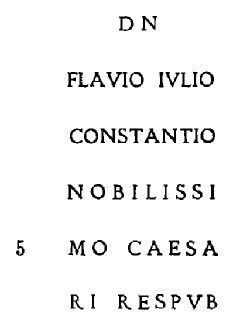
Inscription
D(omino) n(ostro) / Flavio Iulio / Constantio / (4) nobilissi/mo Caesa/ri, res pub(lica) / [Aunobaritanorum?] / [d(evota) n(umini) m(aiestati)q(ue) eius].
Inscription translation
To our lord, Flavius Iulius Constantius, most noble Caesar; the city (res publica) of [Aunobaris (?), devoted to his divine spirit and majesty].
Bibliography
- Merlin, A., Inscriptions latines de la Tunisie, Paris, 1944, no. 593
Discussion
INSCRIPTION
In six surviving lines:
D(omino) n(ostro) / Flavio Iulio / Constantio / (4) nobilissi/mo Caesa/ri, res pub(lica) / [Aunobaritanorum?] / [d(evota) n(umini) m(aiestati)q(ue) eius].
'To our lord, Flavius Iulius Constantius, most noble Caesar; the city (res publica) of [Aunobaris (?), devoted to his divine spirit and majesty].'
The inscription is missing after the words 'res publica' ('city'), and is here given as completed hypothetically by Poinssot (for his justification, see 'Further Discussion' below).
Letter height : 5 cm
DESCRIPTION (from L. Poinssot)
Upper part of a base, with mouldings: H 80, W 52 cm, depth unrecorded. The inscription is framed by a cartouche.
PROVENANCE AND CURRENT LOCATION
Found a few hundred metres northwest of Aïn-Teki in a farmyard orchard. It was last recorded in 1920 (by Poinssot) in this same place.
Aïn-Teki is the site of a small Roman settlement whose name, 'Pagus Thac...', is partially recorded (CIL VIII 27416). However, Poinssot, probably correctly, assumed that the base came from the city of Aunobaris, a few kilometres to the north, and completed the missing part of the inscription accordingly.
HONORAND, AWARDER AND DATE
The honorand, Constantius II, was Caesar from 324 to 337.
The awarder was the city, as usual for imperial statues in Africa.
Discussion references
- Compte-rendus des séances de la Commission de l'Afrique du Nord, Bulletin archéologique du Comité des Travaux Historiques et Scientifiques, Paris, 1920, p. CCXVI
Cite: Last Statues of Antiquity, LSA-1834 (Gabriel de Bruyn).