
LSA-1837
Base for statue of Julian, emperor. Calama (Africa Proconsularis). 355-360
Record details
Photographs
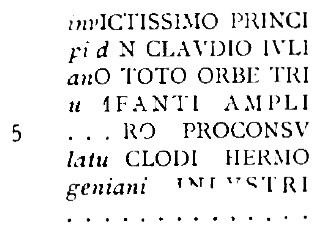
Inscription
[Inv]ictissimo princi/[pi], d(omino) n(ostro) Claudio Iuli/[an]o, toto orbe tri/[u]mfanti, ampli(atori) / (5) [p(opuli)] Ro(mani), procunsu/[latu] Clodi Hermo/[geniani], inlustri[s viri, legatione Atili Theodoti ------]
Inscription translation
To the most unconquered ruler, our lord Claudius Iulianus, triumphant throughout the whole world, having increased the Roman people; under the governorship (proconsulatu) of Clodius Hermogenianus, of illustris rank, [and under the legate Atilius Theodotus...]
Bibliography
- Gsell, S., Inscriptions latines de l’Algérie, vol. I, Paris 1922 (Rome 1965), no. 252
- Lepelley, C., Les cités de l'Afrique romaine au Bas-Empire, t. 2, Notices d'histoire municipale, Paris 1981, p. 95, n. 19
Discussion
INSCRIPTION
In six surviving lines:
[Inv]ictissimo princi/[pi], d(omino) n(ostro) Claudio Iuli/[an]o, toto orbe tri/[u]mfanti, ampli(atori) / (5) [p(opuli)] Ro(mani), procunsu/[latu] Clodi Hermo/[geniani], inlustri[s viri, legatione Atili Theodoti ------]
'To the most unconquered ruler, our lord Claudius Iulianus, triumphant throughout the whole world, having increased the Roman people, under the governorship (proconsulatu) of Clodius Hermogenianus, of illustris rank, [and under the legate Atilius Theodotus...]'
The partial completion of the inscription, with the name of the legate Atilius Theodotus, is as suggested by Gsell. This is on the basis of similar inscriptions from nearby cities, where both Hermogenianus, governor of Africa, and his legate in Numidia, Theodotus, are named (see, for example, ILAlg I 1247 and 2102).
Letter height : 6 cm
DESCRIPTION (from Gsell)
Gsell describes the base as broken and lost, on the left and below line 7 ('brisée à gauche et en bas'). There are no published measurements.
PROVENANCE AND CURRENT LOCATION
There is no published record of its precise find-spot or present location.
HONORAND, AWARDER AND DATE
The honorand, Julian, was Caesar 355-60 and Augustus 360-3.
The end of the inscription, with the name of the awarder, is broken off and lost. Like almost all late antique imperial statues in Africa, our statue was probably ordered by the city itself, though (again following common practice) it was careful to give some reflected credit to the current governor (and his legate).
Julian is not yet designated Augustus on our base, which he was proclaimed by his troops in Paris early in 360, though this title is unlikely to have been recognized in Africa before the death of Constantius II in November 361. The governorship of Quintus Clodius Hermogenianus can be dated independently to the early 360s (PLRE I, 640-2, Olybrius 3). A date of very early 360 is likely for our base, since the city is unlikely to have risked the ire of Julian by deliberately omitting his claim to be Augustus.
Cite: Last Statues of Antiquity, LSA-1837 (Gabriel de Bruyn).