
LSA-184
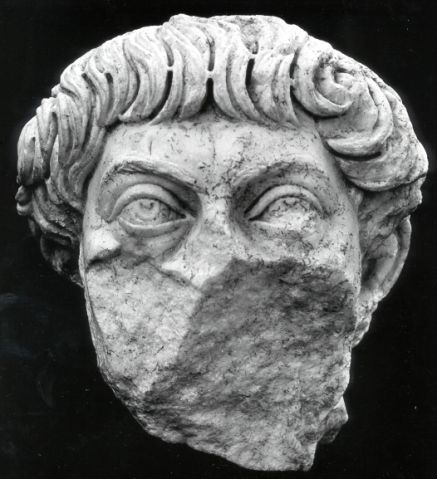
Fragmentry portrait head of man with finely carved brushed forward hair. Aphrodisias (Caria). Fifth century.
Record details
Photographs
Bibliography
- Smith, R.R.R., 'Archaeological research at Aphrodisias 1989-1992', C. Roueché and R.R.R. Smith (eds.), Aphrodisias Papers 3. The setting and quarries, mythological and other sculptural decoration, architectural development, Portico of Tiberius and tetrapylon, JRA Suppl. Series 20, Ann Arbor 1996, 17, no. 2, fig. 7
Discussion
DESCRIPTION (Object)
Fragment of life-size head. H: 26 cm. White marble.
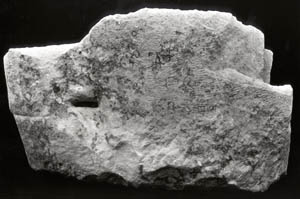
The head is broken in two different planes. One break runs from the middle of the back of the head to the front of the neck. A second runs from beneath the proper left eye back to the base of the mandible. A portion of the back of the head and the lower face are therefore missing. There is also a large chip in the cheek under the right eye.
The hair at the top and back of the head is only perfunctorily indicated by long parallel lines of a claw chisel. The hair around the brow is masterfully drilled and includes ‘bridges’, tiny marble struts, over the deep channels. The eyebrows are carefully engraved onto a raised surface. The pupils are drilled in a U-shape, and the irises are fine engraved lines.
A hole has been drilled into the top of the head in antiquity.
PROVENANCE
Excavated in 1989 at the western end of the pool in the South Agora. It was found with several other heads (for example, LSA-168, LSA-173, LSA-182) and probably belonged to a statue set up in the west portico of the South Agora or forecourt to the Hadrianic Baths.
DESCRIPTION (Subject)
The portrait is of a mature, bearded man. The beard is roughly engraved in short flat-chisel strokes. The hair is brushed forward from the top of the head and from behind the ears onto the temples and brow in heavily drilled, C-shaped locks. The locks fall low on to the brow.
DATE
The technique and style are almost identical to that of the ‘Elder Magistrate’ statue found in the west stoa of the South Agora. The virtuoso carving and hairstyle which builds in volume over the brow indicate a fifth century date.
Cite: Last Statues of Antiquity, LSA-184 (J. Lenaghan).