
LSA-1842
Base for statue of Constantine I, emperor. From Carthage (Africa Proconsularis). 314-324
Record details
Photographs
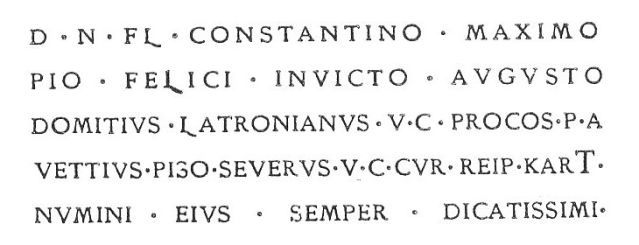
Inscription
D(omino) n(ostro), Fl(avio) Constantino maximo, / pio, felici, invicto Augusto. / Domitius Latronianus, v(ir) c(larissmus), proco(n)s(ul) p(rovinciae) A(fricae), et / Vettius Piso Severus, v(ir) c(larissimus), cur(ator) rei p(ublicae) Kart(haginis), / numini eius semper dicatissimi.
Inscription translation
To our lord, Flavius Constantinus the greatest, pious, fortunate, unconquered Augustus. Domitius Latronianus, of clarissimus rank, governor (proconsul) of the province of Africa, and Vettius Piso Severus, [also] of clarissimus rank, curator of the city of Carthage, [both] most devoted to his divine spirit, [set this up].
Bibliography
- Corpus Inscriptionum Latinarum; , VIII, no. 1016
- Lepelley, C., Les cités de l'Afrique romaine au Bas-Empire, t. 2, Notices d'histoire municipale, Paris 1981, p. 18, no. 3
Discussion
INSCRIPTION
In five lines:
D(omino) n(ostro), Fl(avio) Constantino maximo, / pio, felici, invicto Augusto. / Domitius Latronianus, v(ir) c(larissmus), proco(n)s(ul) p(rovinciae) A(fricae), et / Vettius Piso Severus, v(ir) c(larissimus), cur(ator) rei p(ublicae) Kart(haginis), / numini eius semper dicatissimi.
'To our lord, Flavius Constantinus the greatest, pious, fortunate, unconquered Augustus. Domitius Latronianus, of clarissimus rank, governor (proconsul) of the province of Africa, and Vettius Piso Severus, [also] of clarissimus rank, curator of the city of Carthage, [both] most devoted to his divine spirit, [set this up].'
Letter height : 5-3 cm
DESCRIPTION (from Ducroux)
Rectangular base with large crown: H 61, W 74, D 72 cm. An earlier dedication to Marcus Aurelius had been carved on another face in 151-2 (CIL VIII, 1016)
PROVENANCE AND CURRENT LOCATION
Found by Pricot de Sainte-Marie, between the ruins of the circus and Barhira lake. It is now stored in the Louvre museum (inv. Ma 1865).
HONORAND, AWARDER AND DATE
The honorand, Constantine I, was Augustus from 307 to 337. In 312, the senate granted him the title 'Maximus'. In 324, he replaced invictus, which has pagan connotations, with victor (Lassère, 2005, p. 607).
The first named awarder, Domitius Latronianus, governor (proconsul) of Africa Proconsularis, is known to have been governor of Sicily shortly before 314 (PLRE I, 496, Latronianus 2). His governorship of Africa, a more senior post, must therefore have been after 314. The second awarder, Vettius Piso Severus, curator of the city of Carthage, is known only from this inscription (PLRE I, 836, Severus 27).
FURTHER DISCUSSION
This dedication is an interesting case of an award by the combined efforts of the imperial governor and the civic curator. Normally imperial statues were awarded, either by the civic authorities (the normal practice in Africa), or by the imperial governor.
The re-use of a base dedicated to Marcus Aurelius was perhaps deliberate (in order to carry the aura of one good emperor, Marcus, to his successor Constantine), as suggested by the use of similar spolia, especially on the Arch of Constantine in Rome. There is no evidence to show if the statue was re-carved or if it was left intact with a new dedication, like the bust of Caracalla from Rusicade (Skikda) in Numidia : LSA-1121.
Discussion references
- Ducroux S., Catalogue analytique des inscriptions latines sur pierre conservées au Musée du Louvre, Paris, 1975, p. 29, no. 92
- Jones, A. H. M. et al., The Prosopography of the Later Roman Empire. Vol. I 260-395, Cambridge et al. 1971 (1975)
- Lassère, J.-M., Manuel d'épigraphie romaine, Paris, 2005, 607
Cite: Last Statues of Antiquity, LSA-1842 (Gabriel de Bruyn).