
LSA-1858
Base for statue of Marcus Antonius Rufinus, city patron and benefactor. Abellinum (Campania). Late third to early fourth century.
Record details
Photographs
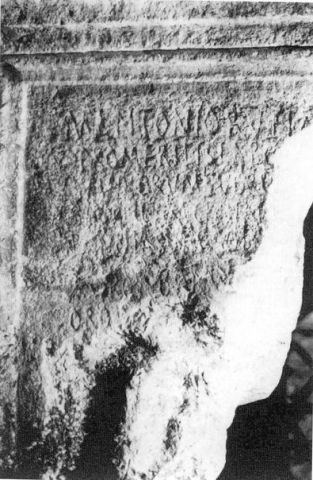
Inscription
M(arco) Antonio Rufino, c(larissimo) v(iro), / pro merito laborum / studiorum suorum, qui / basilicam civitatis nostrae /(5) pecunia sua a solo fecit, / patrono optimo, / ordo splendidissimus / coloniae Abellinatum.
Inscription translation
To Marcus Antonius Rufinus, of clarissimus rank, for the services of his toils and his zeal, who built the basilica of our city with his own funds, excellent patron; the most splendid council of the city (colonia) of Abellinum [set this up].
Bibliography
- Corpus Inscriptionum Latinarum; , X, 1120
- Camodeca, G., I ceti dirigenti di rango senatorio equestre e decurionale della Campania romana, I, Napoli 2008, 42-3
Discussion
INSCRIPTION
In eight lines:
M(arco) Antonio Rufino̲ c̲(larissimo) v̲(iro) / pro meritis labor̲u̲m̲ / studiorum suorum̲ q̲u̲i̲ basilicam civitati̲s̲ n̲o̲s̲t̲r̲a̲e̲ / (5) pecunia sua a solo f̲e̲c̲i̲t / patrono opti̲m̲o̲ / ordo̲ s̲p̲l̲e̲n̲d̲i̲d̲i̲s̲s̲i̲m̲u̲s̲ /c̲o̲l̲o̲n̲i̲̲a̲e̲ A̲b̲el̲li̲n̲at̲i̲u̲̲m̲
'To Marcus Antonius Rufinus, of clarissimus rank, for the services of his toils and his zeal, who built the basilica of our city from the foundations with his own funds, excellent patron; the most splendid council of the city (colonia) of Abellinum [set this up].'
Letter height 3-5 cm.
The underlined portions were recorded in the early 19th century when the inscription was still complete; they are now lost (see below, 'Provenance and Current Location').
DESCRIPTION (from Epigraphic Database Roma (EDR) and the published image)
Fragment of a rectangular base of local stone, with mouldings at top; H 105, W 71, D 65 cm. The right side is broken off from the upper right to the bottom left corner; a part of the inscription that was complete in the early 19th century is now lost (see above, 'Inscription', and below, 'Provenance and Current Location').
PROVENANCE AND CURRENT LOCATION
The inscription was first recorded in the early 19th century in a private house in Atripalda, the location of ancient Abellinum, by the brothers Cassittius (in domo Casp. Aloiffi, CIL). In 1828/9 it was recorded built into the mayory of Atripalda, by the local historian Seraphinus Pionati; at this time only the two last lines were visible (rimpetto alla dogana inversa et ita infixa ut prostent soli duo ultimi versus). Mommsen (for CIL X in 1883) could not trace it, and it was considered lost. The insription was re-discovered in the late 20th or early 21st century (Camodeca 2008, 43: il recente recupero della base).
The inscription is now at Avellino, Museo provinciale Irpino (without published inv. no.).
HONORAND, AWARDER AND DATE
Marcus Antonius Rufinus, the honorand, was of senatorial (clarissimus) rank (no entry in PLRE). He was a patron of the city; our inscription praises him for having built the basilica of the city with his own funds, from the ground – given the notorious grandiloquence of late antique inscription this refers possibly to mere repair works.
No public office is recorded in our inscription; Camodeca 2008, 43 suggested that Marcus Antonius Rufinus was a local man who had reached senatorial rank but did not pursue a career in the imperial service (honoratus clarissimus).
From the epigraphic formula and the letter forms Camodeca 2008 suggested a date in the late 3rd or early 4th century, which we adopt.
The inscription was set up by the city council of Abellinum styled ordo splendidissimuscoloniae Abellinatum (lines 7-8).
Cite: Last Statues of Antiquity, LSA-1858 (preliminary version, discussion added 2/15 (UG)).