
LSA-186
Inscribed base for statue of Eugenius. Aphrodisias (Caria). Sixth century.
Record details
Photographs
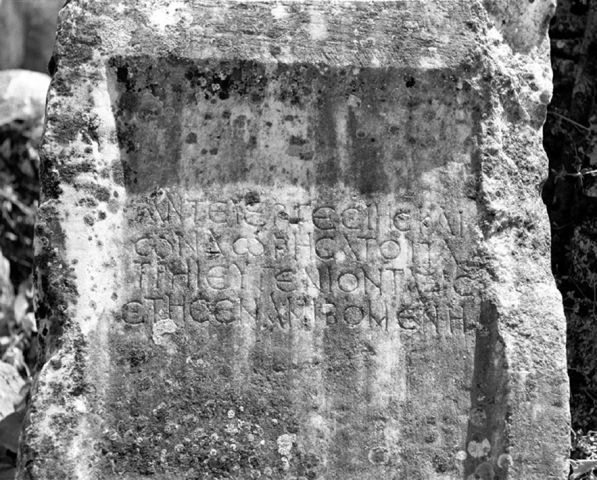
Inscription
ἀντ' εὐεργεσίης καὶ/ ὧν δωρήσατο πά/τρηι Εὐγένιον τάξις /(5) στῆσεν ἀμιβομένη.
Inscription translation
In return for his benefaction, and for the gifts he has made to his country, the ordo set up (a statue of) Eugenius, in repayment.
(Trans: C. Roueché)
Bibliography
- Roueché, C., Aphrodisias in Late Antiquity (Journal of Roman Studies Monograph 5), London 1989, no. 88
Discussion
INSCRIPTION
Verse inscription of one elegiac distich laid out in five lines:
ἀντ' εὐεργεσίης καὶ/ ὧν δωρήσατο πά/τρηι
Εὐγένιον τάξις /(5) στῆσεν ἀμιβομένη.
'In return for his benefaction, and for the gifts he has made to his country, the ordo set up (a statue of) Eugenius, in repayment.' (Trans. C. Roueché)
Letter height 2.5 - 3 cm.
DESCRIPTION (Object)
Tall shaft. H: 156, W: 54, D: 40 cm. Large-grained white marble.
The base is a tall but shallow rectangular shaft. The upper back corners are chipped. The surface is lichen encrusted.
The front panel is framed above and to the sides by moulding. The four-line inscription is set high on the base, and a distinct raised lip, located at 53 cm from the top, separates the upper third of the panel from the lower two-thirds. This suggests that the upper part of the panel was cut back to erase an earlier inscription.
The sides are smoothly finished, and the proper left is slightly concave. The back and top are roughly finished.
There are cuttings for clamps on the proper right and back sides. Two of these seem to have fixed another element to the base: one is in the middle of the base near the upper edge on the proper right side, and a second is at the back near the upper edge towards the proper right side. Two further cuttings at the back may have affixed the base to an architectural setting: one of these is located on the proper right side of the back, 22 cm from the top edge, and the other, which is a large cutting (8 x 12 cm), is centrally located about 70 cm from the top edge. These might belong either to the object’s primary or secondary use.
PROVENANCE AND CURRENT LOCATION
The base was found during the October 1913 excavation of the Hadrianic Baths and now stands in the northern part of the palaestra court.
HONORAND, AWARDER AND DATE
Eugenius, the honorand, is certainly a man of Aphrodisian origin (ὧν δωρήσατο πάτρηι, lines 2-3); he is honoured for his benefactions and gifts towards his hometown (lines 1-3). It is unclear whether he was also a governor or more simply a local notable. This depends upon the interpretation of the honouring body. The word used in Greek, taxis, is used for the officium of a governor. Thus, Drew-Bear 1980 proposes that Eugenius is a governor. Given the brevity of the description, perhaps inappropriate for a governor, taxis might equally mean a local body of city counsellors (Roueché).
The lettering and text suggest a sixth-century date. They resemble those of the base for Rhodopaeus (LSA-188)
Discussion references
- Drew-Bear, T. , 'Recherches épigraphiques et philologiques', Revue des études anciennes 82 (1980), 163 n. 45
Cite: Last Statues of Antiquity, LSA-186 (J. Lenaghan).