
LSA-1861
Base for statue of Caius Lucceius Petilius, city patron. Abellinum (Campania). Fourth century, probably mid-fourth century.
Record details
Photographs
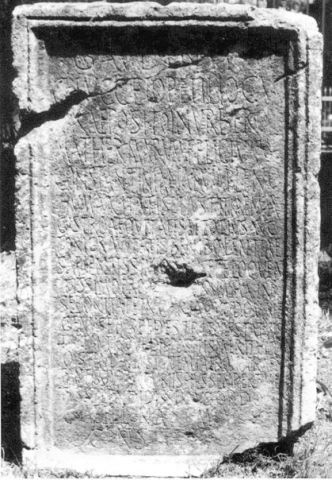
Inscription
Gaudenti. / C(aio) Lucceio Petilio, c(larissimo) v(iro), / praeposito in urbe Ro/ma thermarum felicium /(5) Constantinianarum, pleno / humanitatis et iustitiae, ma/gistro aequitatis et totius auc/tori gravitatis benibolentiae, / sapientissimo et eloquen/tissimo, pro summa in /(11) se bonitate, in curia, quod omne / genus eius pedestribus statuis / tot tantisque dispositis meritum / ostendat insignem, patrono praes/tantissimo, excubiis eius semper ful/tus, splendidissimus ordo /(17) Abell[i]na[tiu]m cens(uit).
Inscription translation
[Statue of] Gaudentius. To Caius Lucceius Petilius, of clarissimus rank, official in charge of the joyful Constantinian baths in the city of Rome, full of humanity and justice, master of fair dealing and source of all gravity and benevolence, most wise and most eloquent; because of his great goodness towards it, the most splendid council (ordo) of Abellinum, always strengthened by his watchfulness, ordered [this]for a most exceptional patron in the council chamber, because his whole family through many standing statues in many parts of the city displays its remarkable merit. (transl. U. Gehn)
Bibliography
- Corpus Inscriptionum Latinarum; , X, 1126
- Camodeca, G., I ceti dirigenti di rango senatorio equestre e decurionale della Campania romana, I, Napoli 2008, 44 with fig. 7
Discussion
INSCRIPTION
Gaudenti. / C(aio) Lucceio Petilio, c(larissimo) v(iro), / praeposito in urbe Ro/ma thermarum felicium /(5) Constantinianarum, pleno / humanitatis et iustitiae, ma/gistro aequitatis et totius auc/tori gravitatis benibolentiae(sic) , / sapientissimo et eloquen/tissimo, pro summa in /(11) se bonitate, in curia, quod omne / genus eius pedestribus statuis / tot tantisque dispositis meritum / ostendat insignem, patrono praes/tantissimo, excubiis eius semper ful/tus, splendidissimus ordo /(17) Abell[i]na[tiu]m cens(uit).
'[Statue of] Gaudentius. To Caius Lucceius Petilius, of clarissimus rank, official in charge of the joyful Constantinian baths in the city of Rome, full of humanity and justice, master of fair dealing and source of all gravity and benevolence, most wise and most eloquent; because of his great goodness towards it, the most splendid council (ordo) of Abellinum, always strengthened by his watchfulness, ordered [this] for a most exceptional patron in the council chamber, because his whole family through many standing statues in many parts of the city displays its remarkable merit'.
Letter height 3.5-6 cm.
DESCRIPTION (from Epigraphic Database Roma (EDR) and the published image)
Rectangular base of local stone; H 117, W 72, D 47 cm. There is a crack at the upper left angle; the bottom right corner is broken, and there is a damage, possibly from a modern tool, at the centre of the epigraphic field.
PROVENANCE AND CURRENT LOCATION
The inscription was found in 1812 in Atripalda, the location of ancient Abellinum, on a field north of the ancient city walls of Abellinum.
It is now in Avellino, Museo Irpino, in the former Bourbon prison (without published inv. no.).
HONORAND, AWARDER AND DATE
Caius Lucceius Petilius signo Gaudentius, the honorand, was of senatorial (clarissimus) rank (PLRE I, 690 C. Lucceius Petilius signo Gaudentius). He is praised for his civic and cultural virtues (lines 5-10) and for benefactions which are however not specified (lines 10-11).
The inscription records the only imperial office of praepositus thermarum Constantinianarum in Rome. This was possibly the office which triggered his elevation to senatorial rank, possibly in the course of the restructuration of the ordo senatorius in 326. Gaudentius was a local man and a member of an established family of Abellinum. Our inscription boasts on his family’s merits (lines 11-14), and members of his family are recorded in the city from the early imperial period on (Camodeca 2008, 44). It is possible that the civic and cultural virtues celebrated in lines 5-10 allude to some high civic office, e.g. that of curator rei publicae or defensor civitatis; however, this is not made explicit. Gaudentius was a patron of his hometown (line 14). He was a honoratus clarissimus with high authority in his local town, but without pursuing a senatorial career in the imperial service.
The inscription was set up by the city council of Abellinum, styled splendidssimus ordo (line 16).
The re-formation of the senate by Constantine in 326 is a probable terminus post quem for our inscription. If, as our inscription suggests, Gaudentius ran the complete cursus of civic offices (which was the condition for the highest offices of curator rei publicae or defensor civitatis, see above, second to last paragraph), it is a reasonable assumption that this inscription was set up towards the middle of the 4th century. A date after 400 is improbable for an inscription to a local notable in the region.
Cite: Last Statues of Antiquity, LSA-1861 (preliminary version, discussion added 2/15 (UG)).