
LSA-187
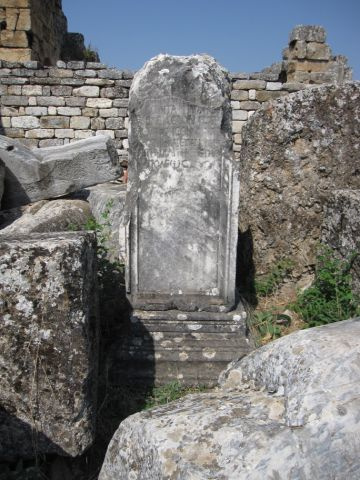
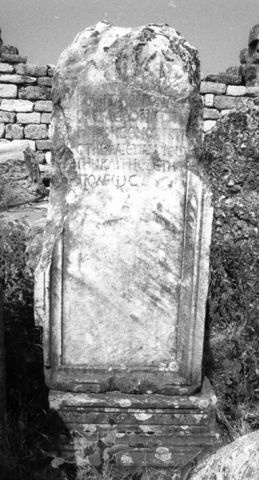
Fragmentary base for statue of comes. Aphrodisias (Caria). First half, probably second quarter, of fourth century.
Record details
Photographs
Inscription
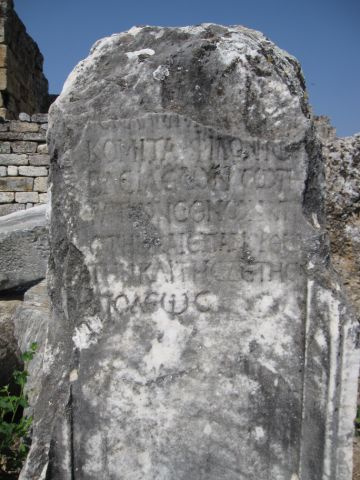
[...] / τὸν λαμπρ[ότατον] / κόμιτα v. φίλον τῶ[ν] /(3) βασιλέων σωτῆ/ρα τῶν ἐθνῶν κτί/στην καὶ ἐπανορθω/τὴν καὶ τῆσδε τῆς πόλεως.
Inscription translation
[The city has honoured so-and-so] the most splendid comes, friend of the emperors, saviour of the provinces, founder and restorer also of this city.
(Trans: C. Roueché)
Bibliography
- Roueché, C., Aphrodisias in Late Antiquity (Journal of Roman Studies Monograph 5), London 1989, no. 14
Discussion
INSCRIPTION
Six lines preserved:
[...] / τὸν λαμπρ[ότατον] / κόμιτα v. φίλον τῶ[ν] /(3) βασιλέων σωτῆ/ρα τῶν ἐθνῶν κτί/στην καὶ ἐπανορθω/τὴν καὶ τῆσδε τῆς πόλεως.
'[The city has honoured so-and-so] the most splendid comes, friend of the emperors, saviour of the provinces, founder and restorer also of this city.' (Trans: C. Roueché)
**'[...set this up to ...], of clarissimus rank, comes, friend of the emperors, saviour of the provinces founder and restorer also of this city.'**
Letter height 3.5 cm.
DESCRIPTION
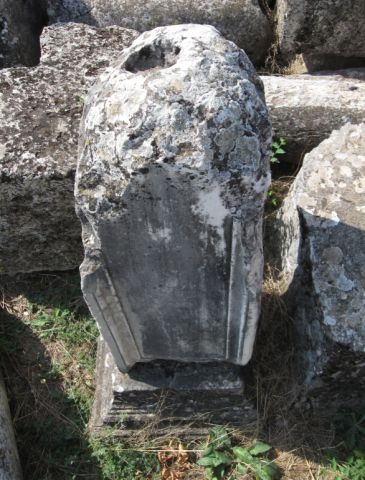
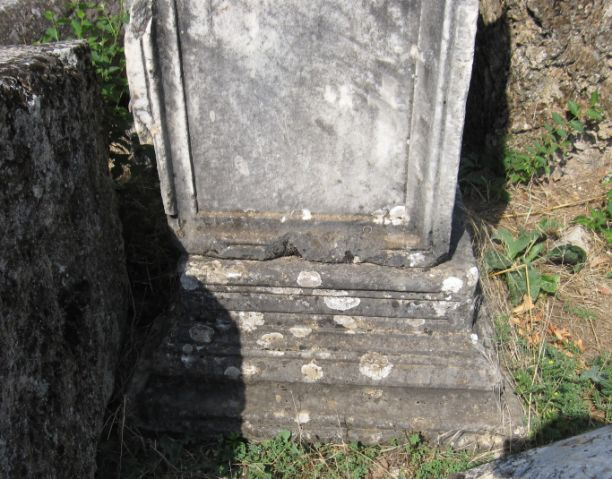
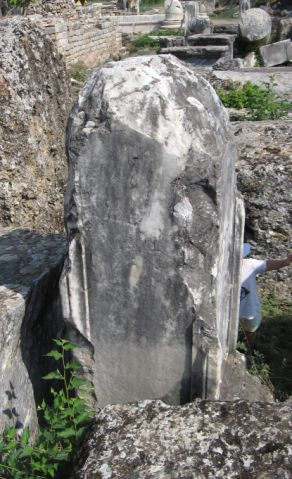
Rectangular base on lower plinth. H: 161, Diam: 52 cm. Lower Plinth H: 36 cm, W: 90 cm, D: 81 cm. White marble.
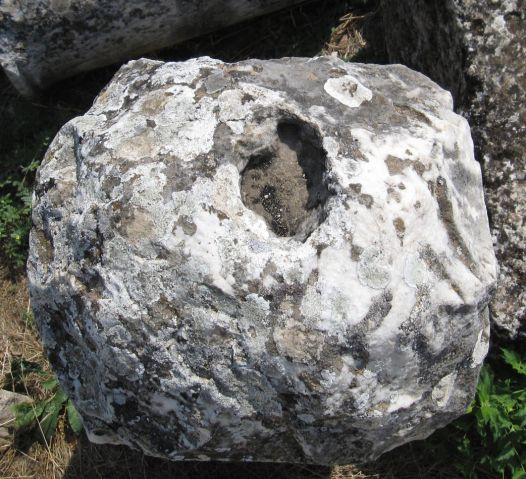
The upper part of the shaft is broken, though the outline of the lewis hole as well as central dowel are still preserved in the top surface. The front and side panels are framed by moulding. The mouldings are heavily chipped. The back of the base has been evenly worked over with a fine point. The lower plinth also has mouldings on all but the back side.
On the proper right side is a graffito of a small cross.
PROVENANCE AND PRESENT LOCATION
Found in 1905 by Mendel in the forecourt on the east side of the Hadrianic Baths. It appears to be still in situ located in front of a pedestal on the west side of the northern part of the forecourt.
HONORAND AND DATE
Roueché dates the base to the earlier fourth century on the basis of the titles and the lettering. Flavius Zenon, who set up two statues in the forecourt of the Baths, is the only other man known as a comes in Aphrodisian inscriptions (see LSA-189 and LSA-190). LSA-221 similarly records a “friend” of the emperors.
Cite: Last Statues of Antiquity, LSA-187 (J. Lenaghan).