
LSA-1879
Base for statue of Gratian, emperor. Madauros (Africa Proconsularis). 367-383
Record details
Photographs
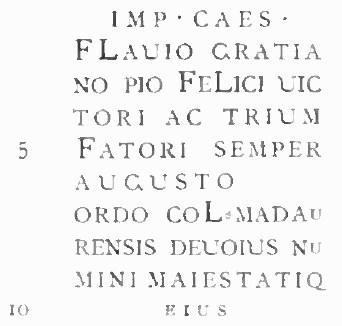
Inscription
[Imp(eratori) Caes(ari)] / Flavio Gratia/no, pio, felici, vic/tori ac trium/fatori, semper / (6) Augusto, / ordo col(oniae) Madau/rensis, devo[t]us nu/mini maiestatiq(ue) / eius.
Inscription translation
To the emperor Caesar Flavius Gratianus, pious, fortunate, victorious and triumphant, eternal Augustus; the council (ordo) of the colony of Madauros, devoted to his divine spirit and majesty, [set this up].
Bibliography
- Gsell, S., Inscriptions latines de l’Algérie, vol. I, Paris 1922 (Rome 1965), no. 2105
- Lepelley, C., Les cités de l'Afrique romaine au Bas-Empire, t. 2, Notices d'histoire municipale, Paris 1981, p. 133, n. 22
Discussion
INSCRIPTION
In ten lines:
[Imp(eratori) Caes(ari)] / Flavio Gratia/no, pio, felici, vic/tori ac trium/fatori, semper / (6) Augusto, / ordo col(oniae) Madau/rensis, devo[t]us nu/mini maiestatiq(ue) / eius.
'To the emperor Caesar Flavius Gratianus, pious, fortunate, victorious and triumphant, eternal Augustus; the council of the colony of Madauros, devoted to his divine spirit and majesty, [set this up]'.
Letter height : 4-6 cm
DESCRIPTION (from Ballu, 1919)
The base appears to have been substantially complete when Ballu first recorded it. When Gsell recorded it again, the first line of the inscription and the top were missing ('Base honorifique cassée dans le haut'). The dimensions are those recorded by Ballu : H 118, W 42 cm, depth unrecorded.
PROVENANCE AND CURRENT LOCATION
Found in 1896, re-used in the east wall of the Byzantine fortress.
The base was last recorded in 1922 by Gsell four metres in front of the wall of the fortress. Gsell suggested that the bases re-used in this part of the fortress may have come from the forum, which is very likely since this this part of the fortress was built over the square. There is no recent published record of its location.
HONORAND, AWARDER AND DATE
The honorand, Gratian, was Augustus from 367 to 383.
The awarder was the city, as usual for imperial statues in Africa.
FURTHER DISCUSSION
This base and another, dedicated to Valentinian I or II (LSA-1878), have the same formula. They may have been set up as a pair, but it is also possible that one of these two bases was erected later than the other, using the same formula in order to show the continuity of imperial power.
Our base to Gratian is narrower than that to Valentinian (42 cm, as against 60 cm; original height uncertain). If the Valentinian concerned was Valentinian I, then, as the senior Augustus, he may have been deliberately honoured with a slightly larger base than Gratian.
Cite: Last Statues of Antiquity, LSA-1879 (Gabriel de Bruyn).