
LSA-1884
Base for statue of Valentinian I, emperor. Rucuma (Africa Proconsularis). 364-375
Record details
Photographs
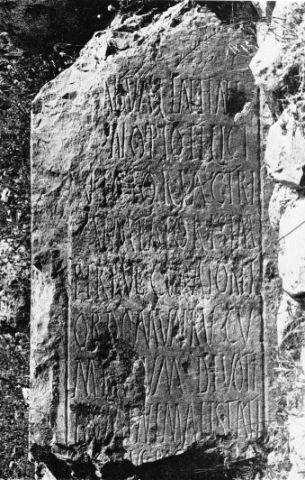
Inscription
[D(omino)] n(ostro) Fl(avio) Valentini/[a]no, pio, felici, / victori ac tri/umfatori, sem/per Aug(usto), curator et / (6) ordo mun(icipii) Rucu/me[nsi]um, devoti / numini maiestati/[q]u[e ei]us, p[e]c[unia publica].
Inscription translation
To our lord Flavius Valentinianus, pious, fortunate, victorious and triumphant, forever Augustus; the curator and the council (ordo) of the city (municipium) of the Rucumenses, [both] devoted to his divine spirit and majesty, [set this up] with public funds.
Bibliography
- L'Année épigraphique, Paris, 1981, no. 879
Discussion
INSCRIPTION
In nine lines:
[D(omino)] n(ostro) Fl(avio) Valentini/[a]no, pio, felici, / victori ac tri/umfatori, sem/per Aug(usto), curator et / (6) ordo mun(icipii) Rucu/me[nsi]um, devoti / numini maiestati/[q]u[e ei]us, p[e]c[unia publica].
'To our lord Flavius Valentinianus, pious, fortunate, victorious and triumphant, eternal Augustus; the curator and the council (ordo) of the city (municipium) of the Rucumenses, [both] devoted to his divine spirit and majesty, [set this up] with public funds.'
Letter height : 10 cm.
DESCRIPTION (from J. Peyras and the published photo)
Base in a hard limestone, broken and lost at the top left corner and at the bottom (destroying parts of the inscription), the surface chipped and eroded in part : H 144, W 67, D 60 cm. The inscribed field is framed by a moulding, and has a polished surface with traces of the lines inscribed to set out the letters. Above the inscription there were once two palm-branches, though only that on the right now survives.
PROVENANCE AND CURRENT LOCATION
There is no record of its precise find-spot or present location.
HONORAND, AWARDER AND DATE
The honorand, Valentinian I, was Augustus from 364 to 375.
The awarders were an unnamed curator (the highest magistrate), and the council (ordo) of Rucuma. Because it is very unusual to refer to the role of the curator in setting up a statue without naming him, Peyras speculates, rather fancifully, that this particular curator had become persona non grata before the inscription had been carved.
Discussion references
- Peyras, J., "Rucuma, cité de l'Afrique proconsulaire, des origines à la conquête arabe", Antiquités Africaines, 16, Paris, 1981, p. 53, no. 1, fig. 1
Cite: Last Statues of Antiquity, LSA-1884 (Gabriel de Bruyn).