
LSA-1886
Base for statue of Constantius I, emperor. Semta (Africa Proconsularis). 305-306
Record details
Photographs
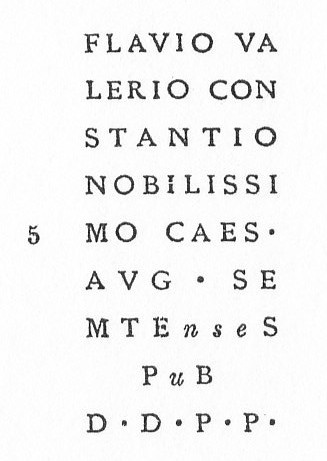
Inscription
Flavio Va/lerio Con/stantio, / (4) nobilissi/mo Caes(ari), / Aug(usto), Se/mte[nse]s, / p[u]b(lice), / d(ecreto) d(ecurionum), p(ecunia) p(ublica).
Inscription translation
To Flavius Valerius Constantius, most noble Caesar, Augustus; the Semtenses [set this up] publicly, by decree of the councillors, with public funds.
Bibliography
- Corpus Inscriptionum Latinarum; , VIII, no. 23115
- Lepelley, C., Les cités de l'Afrique romaine au Bas-Empire, t. 2, Notices d'histoire municipale, Paris 1981, p. 155, n. 4
Discussion
INSCRIPTION
In nine lines:
Flavio Va/lerio Con/stantio, / (4) nobilissi/mo Caes(ari), / Aug(usto), Se/mte[nse]s, / p[u]b(lice), / d(ecreto) d(ecurionum), p(ecunia) p(ublica).
'To Flavius Valerius Constantius, most noble Caesar, Augustus; the Semtenses [set this up] publicly, by decree of the councillors, with public funds.'
Letter height : 6 cm.
The formula 'nobilissimo Caesari Augusto' is unusual, and perhaps a simple error in commemorating an Augustus who had only recently been elevated from the status of Caesar.
DESCRIPTION
There are no published descriptions or measurements of this inscription, and no published image.
PROVENANCE AND CURRENT LOCATION
Found in 1893 by the topographical surveyors of Tunisia, near an 'haouta' (or haoulta) in the centre of the ruins. An 'haouta' is a consecrated place consisting of a circle of stones.
There is no recent published record of its location.
HONORAND, AWARDER AND DATE
The honorand, Constantius I, was Augustus 305 -6.
The awarder was the city, as usual for imperial statues in Africa.
Cite: Last Statues of Antiquity, LSA-1886 (Gabriel de Bruyn).