
LSA-1887
Base for statue of empress Helena, mother of Constantine I. Sicca Veneria (Africa Proconsularis). 325-330
Record details
Photographs
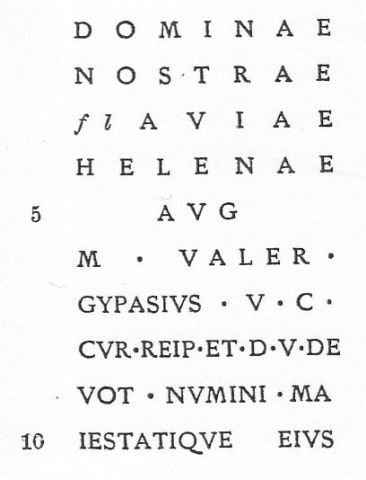
Inscription
Dominae / nostrae, / [Fl]aviae / Helenae, / (5) Aug(ustae), / M(arcus) Valer(ius) / Gypasius, v(ir) c(larissimus), / cur(ator) rei p(ublicae) et d(eae) V(eneris), de/vot(us) numini ma/iestatique eius.
Inscription translation
To our mistress Flavia Helena Augusta; Marcus Valerius Gypasius, of clarissimus rank, curator of the city and goddess Venus, devoted to her divine spirit and majesty, [set this up].
Bibliography
- Corpus Inscriptionum Latinarum; , VIII, no. 1633
- Lepelley, C., Les cités de l'Afrique romaine au Bas-Empire, t. 2, Notices d'histoire municipale, Paris 1981, p. 159, n. 15
Discussion
INSCRIPTION
In ten lines:
Dominae / nostrae, / [Fl]aviae / Helenae, / (5) Aug(ustae), / M(arcus) Valer(ius) / Gypasius, v(ir) c(larissimus), / cur(ator) rei p(ublicae) et d(eae) V(eneris), de/vot(us) numini ma/iestatique eius.
'To our mistress Flavia Helena Augusta; Marcus Valerius Gypasius, of clarissimus rank, curator of the city and goddess Venus, devoted to her divine spirit and majesty. [set this up].'
Lepelley correctly expands the 'D V' in line 8 to 'd(eae) V(eneris), of the goddess Venus', on the basis of another inscription (CIL VIII no. 15881) mentioning a 'curator Siccensium et Veneris'. Marcus Valerius Gypasius was presumably in charge of the city's famous temple of the goddess.
DESCRIPTION (from Guérin)
White marble pedestal ("sur un piédestal en marbre blanc"), presumably with plinth and crown. Neither Guérin nor the CIL give measurements.
PROVENANCE AND CURRENT LOCATION
Found by Guérin who first published it in 1862. There is no recent published record of its location.
HONORAND, AWARDER AND DATE
The honorand, Flavia Helena, mother of the emperor Constantine I, was Augusta from approximately 325, and died about 330 (See Lepelley, 1981, 159).
The awarder, Marcus Valerius Gypasius, curator of the city and of the goddess Venus, is known only from our inscription (PLRE I, 405, Gypasius).
Discussion references
- Guérin, V., , Voyage archéologique dans la Régence de Tunis, Paris, 1862, II, p. 65, no. 244
Cite: Last Statues of Antiquity, LSA-1887 (Gabriel de Bruyn).