
LSA-1888
Base for statue of Constantius II, emperor. From Sicca Veneria (Africa Proconsularis). 337-361
Record details
Photographs
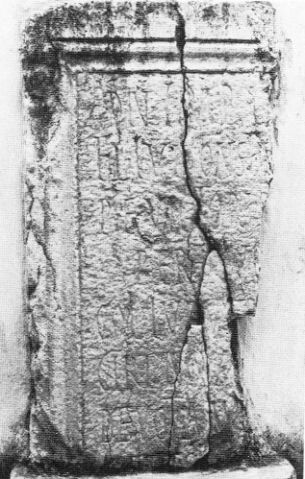
Inscription
D(omino) n(ostro), imp(eratori) C[aes(ari)] / Fl(avio) Iul(io) Consta[ntio], / p(io), f(elici), victori, s[em]/per Aug(usto); col(onia) Iul(ia) V[eneria] / (5) Cirta Nova [Sicca], / devota n[umini] / [maiestatiq(ue) eius].
Inscription translation
To our lord, the emperor Caesar Flavius Iulius Constantius, pious, fortunate, victorious, forever Augustus, the Julian Venusian colony of Cirta Nova Sicca, devoted to his divine spirit and majesty, [set this up].
Bibliography
- Ben Abdallah, Z. B., Catalogue des inscriptions latines païenne du Musée du Bardo, Rome 1986, no. 234
- Lepelley, C., Les cités de l'Afrique romaine au Bas-Empire, t. 2, Notices d'histoire municipale, Paris 1981, p. 159, no. 2, n. 16
Discussion
INSCRIPTION
In six surving lines:
D(omino) n(ostro), imp(eratori) C[aes(ari)] / Fl(avio) Iul(io) Consta[ntio], / p(io), f(elici), victori, s[em]/per Aug(usto), col(onia) Iul(ia) V[eneria] / (5) Cirta nova [Sicca], / devota n[umini] / [maiestatiq(ue) eius].
'To our lord, the emperor Caesar Flavius Iulius Constantius, pious, fortunate, victorious, forever Augustus; the Julian Venusian colony of Cirta Nova Sicca, devoted to his divine spirit and majesty, [set this up].'
Letter height : 6 cm
DESCRIPTION (from ILPB and the published photo)
Rectangular limestone base, broken and lost on the right towards the bottom : H 85, W 47 cm, depth unrecorded. The text is framed by a moulding. The surface is badly cracked and pitted.
PROVENANCE AND CURRENT LOCATION
There is no published record of the precise findspot. It is now in the Bardo museum (Inv. D 410)
HONORAND, AWARDER AND DATE
The honorand, Constantius II, was Augustus 337-61.
The awarder was the city, as usual for imperial statues in Africa. Sicca is described as 'Iulia' because a colony was founded by Octavius before 27 B.C., and as 'Veneria' because of a famous temple dedicated to the Phoenician Ashtart, identified with Venus by the Romans. The name 'Cirta nova' cannot readily be explained. P. Salama thought Sicca received the name as capital of the province of Africa Nova, between 43 and 39 B.C. (see Lepelley, 1981, p. 156, n. 5).
Cite: Last Statues of Antiquity, LSA-1888 (Gabriel de Bruyn).