
LSA-189
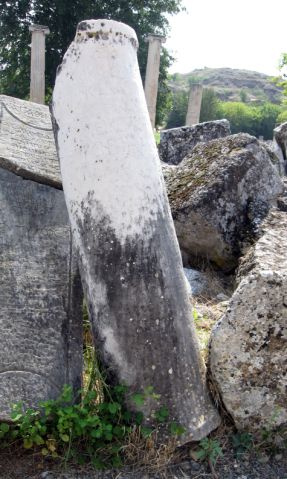
Base for statue (subject unspecified) set up by Flavius Zeno. Aphrodisias (Caria). Fourth century.
Record details
Photographs
Inscription
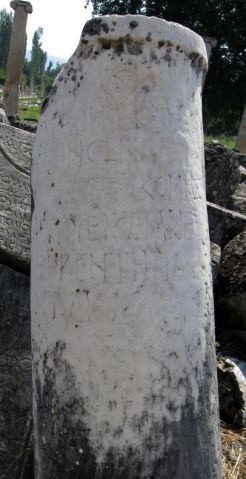
Ἀγαθῇ Τύχῃ / Φλ(άουιος) Ζήνων ἀρχ[ιε/ρεὺς καὶ] κόμης /(4) ἐποίει καὶ ἀνέ/θηκεν τῇ πα/τρίδι. leaf
Inscription translation
With Good Fortune. Fl(avius) Zeno [high priest and] ?comes, made (this) and set it up for his homeland.
(Trans: C. Roueché)
Bibliography
- Roueché, C., Aphrodisias in Late Antiquity (Journal of Roman Studies Monograph 5), London 1989, no. 11
- Roueché, C. and K. Erim, 'Sculptors from Aphrodisias: New Inscriptions', Papers of the British School at Rome, 50, London 1982, 103-104, no. 1, pl IVb
Discussion
INSCRIPTION
In six lines:
Ἀγαθῇ Τύχῃ / Φλ(άουιος) Ζήνων ἀρχ[ιε/ρεὺς καὶ] κόμης /(4) ἐποίει καὶ ἀνέ/θηκεν τῇ πα/τρίδι. leaf
'With Good Fortune. Fl(avius) Zeno [high priest and] ?comes, made (this) and set it up for his homeland.' (Trans: C. Roueché)
Letter height 5-6 cm.
DESCRIPTION (Object)
Narrow columnar base. H: 169, Diam: 44 cm. White marble.
The shaft is broken at the top, mainly on the back side. It has simple mouldings above and below. The front has been smoothed but the back remains roughly worked. The top surface preserves the ghost of a lewis hole and anathyrosis at the front edge.
The five-line inscription is set under the upper moulding. Line two begins further to the left than any of the other lines; as if the initials, Fl, of the nomen were an afterthought. The end of line and the first seven letters of line three have been deliberately erased.
PROVENANCE
Excavated by Boulanger in 1913 in the northern area of the forecourt of the Hadrianic Baths.
DEDICATOR AND DATE
Flavius Zenon is a high priest which indicates a position of local or provincial rank. The word priest has been deliberately erased but is preserved in another dedication which he made, LSA-190. The gentilicium Flavius, seemingly added here to the text, was adopted by individuals throughout the empire beginning in the second quarter of the fourth century in conjunction with the sole reign of Constantine. Comes is also a title that became widespread in the Constantinian period, so widespread that different grades were introduced. Thus, Flavius Zenon was probably a prominent Aphrodisian of the earlier fourth century who did not, however, hold any government post.
The same man made and dedicated posthumously another statue at Aphrodisias, LSA-190. His name also appears on four or five plinths in Rome which read Fl(avius) Zeno, high priest and perfectissimus, of Aphrodisias, made this. These are (1) on a plinth with a tree trunk and leg (published in 1731 = CIG 5899 = Squarciapino no. 20), (2) an identical inscription on plinth with a foot excavated in 1874 and published in 1880 (= IG XIV 1268 = Squarcipaino no. 19), (3-5) excavated on the Esquiline in 1886 = IG XIV 1269, 1270, 1271). He seems more likely to have been the owner of a studio, probably a dealer in recycling and repairing of art works, rather than a sculptor.
The signatures of Flavius Zenon on the Esquiline were found in conjunction with, two other Aphrodisians. One of these is Flavius Andronicus who is also attested at Aphrodisias as having made and dedicated a statue, see LSA-2564.
Cite: Last Statues of Antiquity, LSA-189 (J. Lenaghan).