
LSA-1891
Base for statue of Julian, emperor, apparently set on an arch. Sua (Africa Proconsularis). 361-363
Record details
Photographs
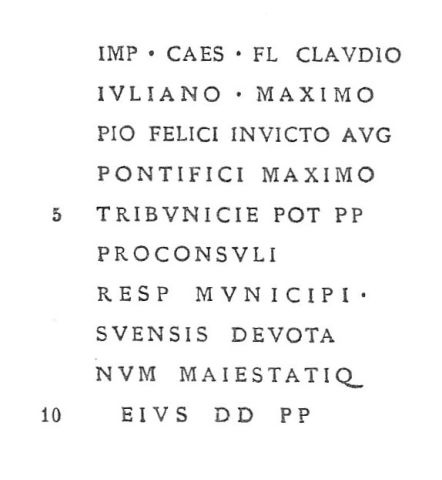
Inscription
Imp(eratori) Caes(ari) Fl(avio) Claudio / Iuliano, maximo, / pio, felici, invicto Aug(usto), / pontifici maximo, / (5) tribunici(a)e pot(estatis), p(atri) p(atriae), / proco(n)suli, / res p(ublica) municipi(i) / Suensis, devota / num(ini) maiestatiq(ue) / eius, d(ecreto) d(ecurionum), p(ecunia) p(ublica).
Inscription translation
To the emperor Caesar Flavius Claudius Iulianus, the greatest, pious, fortunate, unconquered Augustus, highest priest, holding tribunician power, father of the fatherland, proconsul. The community of the city (municipium) of Sua, devoted to his divine spirit and majesty, [set this up] by decree of the councillors, with public funds.
Bibliography
- Corpus Inscriptionum Latinarum; , VIII, no. 25849
- Lepelley, C., Les cités de l'Afrique romaine au Bas-Empire, t. 2, Notices d'histoire municipale, Paris 1981, p. 165, n. 4
Discussion
INSCRIPTION
In ten lines:
Imp(eratori) Caes(ari) Fl(avio) Claudio / Iuliano, maximo, / pio, felici, invicto Aug(usto), / pontifici maximo, / (5) tribunici(a)e pot(estatis), p(atri) p(atriae), / proco(n)suli, / res p(ublica) municipi(i) / Suensis, devota / num(ini) maiestatiq(ue) / eius, d(ecreto) d(ecurionum) p(ecunia) p(ublica).
'To the emperor Caesar Flavius Claudius Iulianus, the greatest, pious, fortunate, unconquered Augustus, highest priest, holding tribunician power, father of the fatherland, proconsul. The community of the city (municipium) of Sua, devoted to his divine spirit and majesty, [set this up] by decree of the councillors, with public funds.'
DESCRIPTION (from CIL)
Of this base, CIL gives no description nor measurements, other than to say it was part of an arch, though without further details it is impossible to know how reliable this information is.
PROVENANCE AND CURRENT LOCATION
Found in front of an arch from which it apparently came. There is no recent published record of its location.
HONORAND, AWARDER AND DATE
The honorand, Julian, was Augustus 360 to 363, though unlikely to have been recognised in Africa before the death of Constantius II in 361.
The awarder was the city, as usual for imperial statues in Africa.
FURTHER DISCUSSION
Lepelley rightly points out the archaic formula of the titulature, which fits with Julian's politicals ideals (see Lepelley, 1981, 165, n. 4).
Cite: Last Statues of Antiquity, LSA-1891 (Gabriel de Bruyn).