
LSA-1895
Base for statue of Valentinian I, emperor. Thabbora (Africa Proconsularis). 364-375
Record details
Photographs
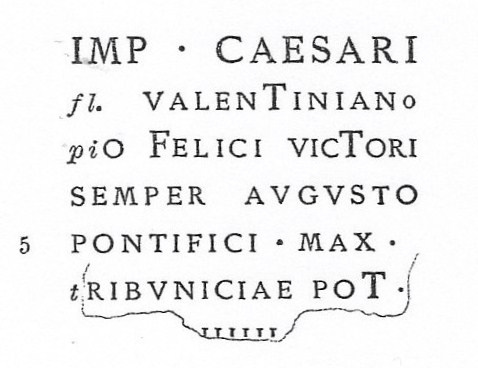
Inscription
Imp(eratori) Caesari / [Fl(avio)] Valentiniano, / [pi]o, felici, victori, / semper Augusto, / (5) pontifici max(imo), / [t]ribuniciae pot(estatis) / [---
Inscription translation
To the emperor Caesar Flavius Valentinianus, pious, fortunate, victorious, forever Augustus, highest priest, holding tribunician power...
Bibliography
- Corpus Inscriptionum Latinarum; , VIII, no. 12321
Discussion
INSCRIPTION
In six surving lines:
Imp(eratori) Caesari / [Fl(avio)] Valentiniano, / [pi]o, felici, victori, / semper Augusto, / (5) pontifici max(imo), / [t]ribuniciae pot(estatis) / [---
'To the emperor Caesar Flavius Valentinianus, pious, fortunate, victorious, eternal Augustus, highest priest, holding tribunician power...'
DESCRIPTION (from CIL)
From the way it is laid out in CIL, it is clear that the base is broken and lost after line 6. There are no published measurements.
PROVENANCE AND CURRENT LOCATION
There is no published record of its precise findspot or present location.
HONORAND, AWARDER AND DATE
The honorand, Valentinian I, was Augustus from 364 to 375.
The end of the inscription, with the name of the awarder, is broken off and lost. Like almost all late antique imperial statues in Africa, our statue was probably ordered by the city itself.
Cite: Last Statues of Antiquity, LSA-1895 (Gabriel de Bruyn).