
LSA-1897
Base for statue of Gratian, emperor. Thagari Maius (Africa Proconsularis). 367-378
Record details
Photographs
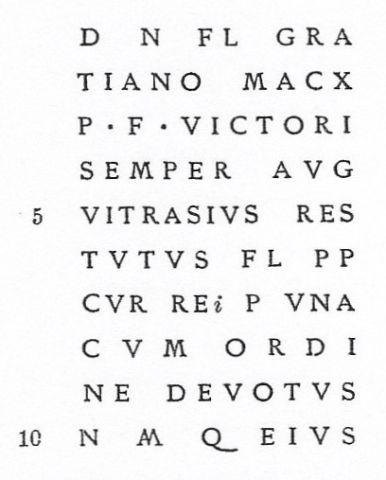
Inscription
D(omino) n(ostro) Fl(avio) Gra/tiano, macx(imo) (sic), / p(io), f(elici), victori, / semper Aug(usto), / (5) Vitrasius Res/tutus, fl(amen) p(er)p(etuus), / cur(ator) re[i] p(ublicae), una / cum ordi/ne, devotus / n(umini) m(aiestati)q(ue) eius.
Inscription translation
To our lord Flavius Gratianus, the greatest, pious, fortunate, victorious, forever Augustus; Vitrasius Restutus, priest in perpetuity, curator of the city, devoted to his divine spirit and majesty, [set this up] along with the council (ordo).
Bibliography
- Corpus Inscriptionum Latinarum; , VIII, no. 12360
- Lepelley, C., Les cités de l'Afrique romaine au Bas-Empire, t. 2, Notices d'histoire municipale, Paris 1981, p. 174-175
Discussion
INSCRIPTION
In nine lines:
D(omino) n(ostro) Fl(avio) Gra/tiano, macx(imo) (sic), / p(io), f(elici), victori, / semper Aug(usto), / (5) Vitrasius Res/tutus, fl(amen) p(er)p(etuus), / cur(ator) re[i] p(ublicae), una / cum ordi/ne, devotus / n(umini) m(aiestati)q(ue) eius.
'To our lord Flavius Gratianus, the greatest, pious, fortunate, victorious, forever Augustus; Vitrasius Restutus, priest in perpetuity, curator of the city, devoted to his divine spirit and majesty, [set this up] along with the council (ordo).'
Letter height : 5 cm
DESCRIPTION (from CIL)
Of this base Poinssot and the CIL give no description, other than its measurements and to say it is of limestone : H 100, W 50 cm, depth unrecorded.
PROVENANCE AND CURRENT LOCATION
Found in 1882-3 by J. Poinssot. There is no record of its precise findspot or present location.
HONORAND, AWARDER AND DATE
The honorand, Gratian, was Augustus from 367 to 383.
The awarder, Vitrasius Restutus, curator (chief magistrate) of the city, dedicated another base in Thagari Maius, to Valens (LSA-1898). He is known only from these two inscriptions, and has no entry in PLRE. As the two bases have the same formula, it is almost certain they were erected at the same time. If so, since Valens died in 378, our base must have been dedicated between 367 and 378.
FURTHER DISCUSSION
There may well have been a third statue, dedicated to Valentinian I or Valentinian II, making up a complete imperial group. The most likely dedicatee is Valentinian I (364-375).
Cite: Last Statues of Antiquity, LSA-1897 (Gabriel de Bruyn).