
LSA-190
Base for statue (subject unstated) set up posthumously by Flavius Zeno. Aphrodisias (Caria). Fourth century.
Record details
Photographs
Inscription
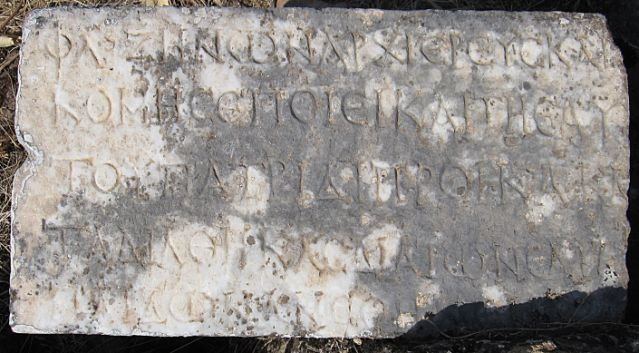
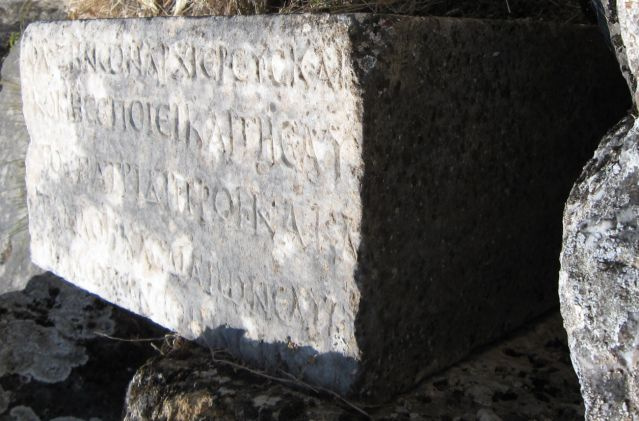
Φλ(άβιος) Ζήνων ἀρχιερεὺς καὶ / κόμης ἐποίει καὶ τῇ ἑαυ/τοῦ πατρίδι προῖκα κα/τὰ διαθήκας διὰ τῶν ἑαυτ(οῦ) /(5) παίδων ἀνέθηκεν. leaf
Inscription translation
Fl(avius) Zeno, high priest and comes, made this and set it up for his own homeland at his own expense, according to (the terms of) his will (carried out) by his own children.
(Trans: C. Roueché)
Bibliography
- Roueché, C., Aphrodisias in Late Antiquity (Journal of Roman Studies Monograph 5), London 1989, no. 12
- Roueché, C. and K. Erim, 'Sculptors from Aphrodisias: New Inscriptions', Papers of the British School at Rome, 50, London 1982, 103-104, no. 2, pl. VIIa
Discussion
INSCRIPTION
In five lines:
Φλ(άβιος) Ζήνων ἀρχιερεὺς καὶ / κόμης ἐποίει καὶ τῇ ἑαυ/τοῦ πατρίδι προῖκα κα/τὰ διαθήκας διὰ τῶν ἑαυτ(οῦ) /(5) παίδων ἀνέθηκεν. leaf
'Fl(avius) Zeno, high priest and comes, made this and set it up for his own homeland at his own expense, according to (the terms of) his will (carried out) by his own children.' (Trans: C. Roueché)
Letter height 3-4 cm.
DESCRIPTION
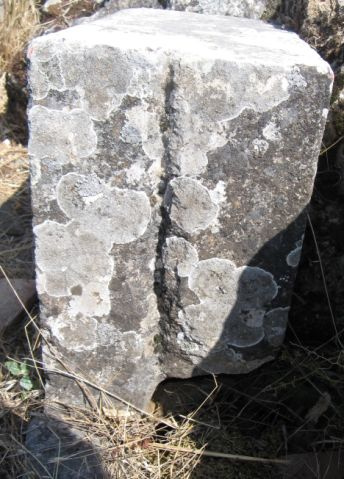
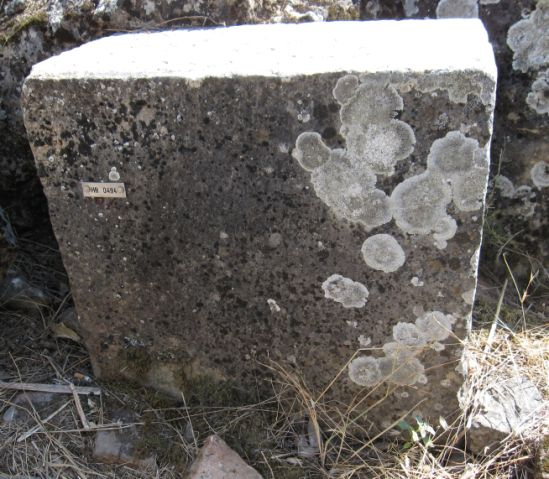
Short squat block without moulding. H: 30, W: 55.5, D: 52 cm. White marble.
The rectangular block is carefully finished, without traces of tooling, on the top, front, and proper left sides. The back side is not currently visible. The proper right side preserves a narrow channel which runs through the middle of the block for its entire depth. The block clearly originally had an architectural function and has been re-used. In its re-use it was probably part of a larger construct which served to support a statue.
PROVENANCE
Excavated by Boulanger in 1913 in the northern area of the forecourt of the Hadrianic Baths. It was apparently in the centre of the northern forecourt.
DEDICATOR AND DATE
The dedicator is the same Flavius Zenon who made and dedicated the statue set on LSA-189. The difference is that this is a posthumous dedication. The two inscriptions for dedications, both set up in the eastern forecourt of the Hadrianic Baths, call Flavius Zenon a high priest (here not erased) and a comes. This indicates that he held a position of local or provincial rank and that he was probably active in the early fourth century when the term comes was used in a variety of grades. His gentilicium Flavius, often assumed by individuals throughout the empire beginning in the second quarter of the fourth century in conjunction with the sole reign of Constantine, confirms the date.
This man is known also from a series of ‘signed’ statue plinths in Italy. These four or five plinths in Rome read Fl(avius) Zeno, high priest and perfectissimus, of Aphrodisias, made this. These are (1) on a plinth with a tree trunk and leg (published in 1731 = CIG 5899 = Squarciapino no. 20), (2) an identical inscription on plinth with a foot excavated in 1874 and published in 1880 (= IG XIV 1268 = Squarcipaino no. 19), (3-5) excavated on the Esquiline in 1886 = IG XIV 1269, 1270, 1271). He seems more likely to have been the owner of a studio, probably a dealer in recycling and repairing of art works, rather than a sculptor.
The signatures of Flavius Zenon in Rome were found in conjunction with the signatures of two other Aphrodisians, Flavius Chryseros and Flavius Andronicus. The latter, Flavius Andronicus, is also attested at Aphrodisias as having made and dedicated a statue, see LSA-2564.
Cite: Last Statues of Antiquity, LSA-190 (J. Lenaghan).