
LSA-1906
Base for statue (subject unstated), erected by Postumius Lampadius, governor of Campania. Neapolis (Campania). Late fourth to early fifth century.
Record details
Photographs
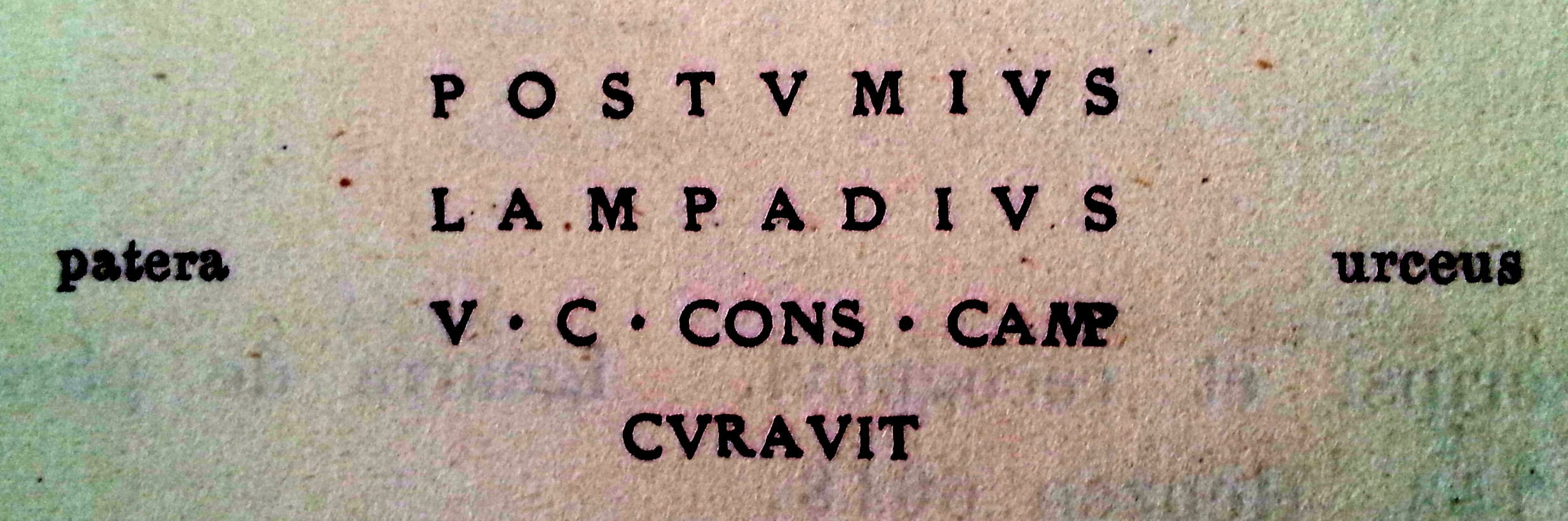
Inscription
Postumius / Lampadius, / v(ir) c(larissimus), cons(ularis) Camp(aniae), / curavit.
Inscription translation
Postumius Lampadius, of clarissimus rank, governor (consularis) of Campania, took care [of it].
Bibliography
- Corpus Inscriptionum Latinarum; , X, 1704
- Camodeca, G. "Ricerche su Puteoli tardoromana (fine III-IV secolo)", Puteoli, 4-5, 1980-1981, 60-1
Discussion
INSCRIPTION
In four lines:
Postumius / Lampadius / v(ir) c(larissimus) cons(ularis) Camp(aniae) / curavit.
Postumius Lampadius, of clarissimus rank, governor (consularis) of Campania, took care.
Letter height not recorded.
The epigraphic formula suggests that this was a statue base set up or re-erected by an imperial office holder.
DESCRIPTION (from CIL)
CIL, the only publisher of the inscription so far, has no description of the block. No measurements are published, and there is no published image.
The drawing of the inscription by CIL records a sacrificial bowl (patera) on the left side (from viewer), and a jug (urceus) on the right. This suggests that our base was originally an altar.
PROVENANCE AND CURRENT LOCATION
The inscription was first recorded in Napoli by the Renaissance scholar Johannes Iucundus in the late-15th/ early-16th century (in vico dicto la Giogiosa). It was again recorded in Naples, in front of a church of St Mary, by the scholar Mariangelus Accursius in the earlier 16th century (avanti la chiesa di Santa Maria Rotonda, and again, in front of the church of the Archangel (probably the church of Michael the Archangel), by the Spanish scholar and bishop of Alifa, Antonius Augustinus, in the mid-16th century (iuxta fores S. Archangeli). (WHY DID PLRE SAY IT WAS IN PUTEOLI?).
There is no recent record of its location.
HONORAND, AWARDER AND DATE
The subject of the dedication is not recorded on our inscription. As in similar cases, it was probably a mythical subject (a deity or a hero), or an emperor of the earlier imperial period (see LSA-1240).
Postumius Lampadius, the awarder, was of senatorial (clarissimus) rank (PLRE II, 656 Postumius Lampadius 7). He was governor (consularis) of Campania. Later in his career he was promoted to the higher ranking offices of prefect of the city of Rome (in 403/8) and of praetorian prefect (in 409); the latest possible date for our inscription is therefore 407. We think it is a safe assumption that Lampadius held the governorship in Campania not long before he became prefect of the city, hence in the late 4th/early 5th century.
Postumius Lampadius was honoured with a statue in Capua, LSA-1942.
Cite: Last Statues of Antiquity, LSA-1906 (preliminary version, discussion added 4/15 (UG)).