
LSA-191
Columnar base for statue of Menander. Aphrodisias (Caria). Later fourth century.
Record details
Photographs
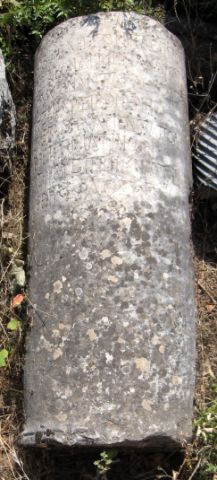
Inscription
leaf ἡ βουλὴ τὸν πᾶσι προς/ηνέα τόνδε Μένανδρον /
πολλῶν ἀντ' ἀγαθῶν / στῆσεν ἀμειβομένη /(5) ὃς μεγάλῃ χαρίεντα πόλι / θρεπτήρια τίνων / δασμοὺς πρηΰνας πᾶσιν / ἔθηκε φάος leaf
Inscription translation
The Council, in exchange for many benefits, set up this (statue of) Menander, who was affable to all, and who, making a welcome repayment for his rearing to the great city, moderated (her) tribute, and established light for all.
Trans. C. Roueché
Bibliography
- Robert, L., Epigrammes du Bas-Empire (Hellenica IV), Paris 1948, 133-5
- Roueché, C., Aphrodisias in Late Antiquity (Journal of Roman Studies Monograph 5), London 1989, no. 24
Discussion
INSCRIPTION
Verse inscription of two elegiac distichs laid out in eight lines:
leaf ἡ βουλὴ τὸν πᾶσι προς/ηνέα τόνδε Μένανδρον /
πολλῶν ἀντ' ἀγαθῶν / στῆσεν ἀμειβομένη /
(5) ὃς μεγάλῃ χαρίεντα πόλι / θρεπτήρια τίνων /
δασμοὺς πρηΰνας πᾶσιν / ἔθηκε φάος leaf
'The Council, in exchange for many benefits, set up this (statue of) Menander, who was affable to all, and who, making a welcome repayment for his rearing to the great city, moderated (her) tribute, and established light for all.' (Trans: C. Roueché)
Letter height 5 - 6.5 cm.
DESCRIPTION
Column shaft with simple lower moulding. H: 145, Diam: 55 cm. White marble.
The column is intact and well-preserved with only minor chips in the lower moulding. It has been re-used as a base. The top surface is picked within a band of anathyrosis; another element was fitted on top of it. At the centre of the proper right side is an area that has been cut back with a rough pick (ca. 40 x 13 cm). On the proper left side is a similar area which begins approximately at the centre and continues through the lower moulding ( ca. 90 x 10 cm). These cuttings on the side suggest a placement within an architectural frame.
PROVENANCE AND CURRENT LOCATION
Excavated in 1905 in the area east of the Hadrianic Baths, on the south side of this area. It currently lies in the southern part of the western portico of the South Agora.
HONORAND, AWARDER AND DATE
The base tells us that this Menander was a native of Aphrodisias who had the authority to decrease taxes. Robert identified this Menander with a vicar of Asiana of the same name who was in office in May 385 and out of office by 388 (PLRE I, p. 596, Menander 7). Roueché acknowledges that this cannot be proven but accepts that it correponds well with the content and lettering (see, for example, LSA-223 and LSA-234, both of the third quarter of the fourth century.)
Cite: Last Statues of Antiquity, LSA-191 (J. Lenaghan).