
LSA-192
Base for statue of Hermias, benefactor. Aphrodisias (Caria). Late fifth to sixth century.
Record details
Photographs
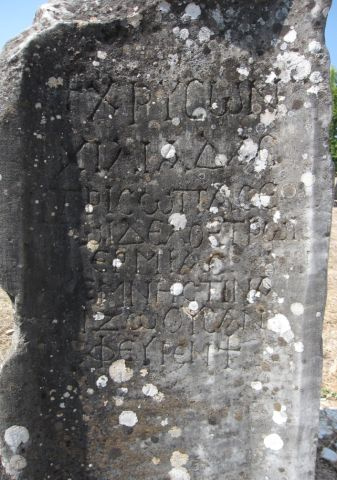
Inscription
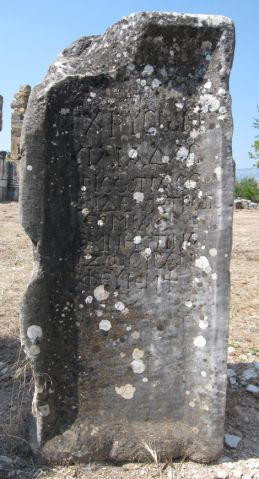
cross χρυσῶν / χιλιάδας / τρῖς ὤπασε / τῶιδε λοετρῶι / Ἑρμίας / κὲ μνῆστιν ἀ /ειζώουσαν / ἐφεῦρεν cross
Inscription translation
Hermias gave three thousands of gold to this bath, and obtained an everliving fame (i.e. (lit.) memory).
(Trans: C. Roueché)
Bibliography
- Roueché, C., Aphrodisias in Late Antiquity (Journal of Roman Studies Monograph 5), London 1989, no. 74
Discussion
INSCRIPTION
Verse inscription of two hexameters laid out in seven lines:
cross χρυσῶν / χιλιάδας / τρῖς ὤπασε / τῶιδε λοετρῶι /
(5) Ἑρμίας / κὲ μνῆστιν ἀ/ειζώουσαν ἐφεῦρεν cross .
Hermias gave three thousands of gold to this bath, and obtained an everliving fame (i.e. (lit.) memory). (Trans: C. Roueché)
Letter height 3-7 cm.
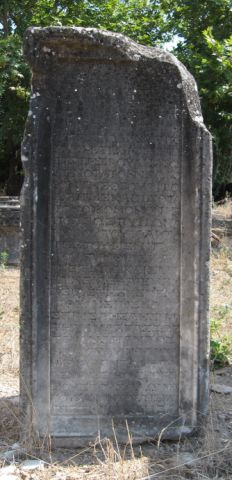
The inscription on the front side (late 2nd/early 3rd century) was probably plastered over and seems to have been moved to the Baths from another location. It (IAph = http://insaph.kcl.ac.uk/iaph2007>, at 5.204) reads,
[·· c. 7 ·· ?καὶ οἱ χρυ] / σοφόροι νεοποιοὶ̣ / τῆς ἁγιωτάτης / θεοῦ Ἀφροδείτης / παρὰ τῇ ἀσύλῳ / θεῷ stop κατὰ τὰ δο /ξαντα διά τε v. ψη/φισμάτων καὶ ὑπο/μνημάτων τῆς κρa/τίστης βουλῆς τὸν / ἁγνότατον νεωκο/ρον τῆς θεοῦ Ἀφρο/δείτης καὶ πιστότ̣α / τὸν οἰκονόμον τῆς / πόλεως Πύ̣ρ̣ρωνα / Ἰθάρου τοῦ Ἰθάρου τρὶς τοῦ Μενιπ scroll /που εὐνοίας καὶ / πίστεως καὶ εἰλι/κρινείας καὶ εὐσε/βείας τῆς περὶ τὴν / v. θεὸν εἵνεκα v. / ἐπιμελησαμένου / τῆς ἀναστάσεως / τοῦ ἀνδρίαντος / Μάρκου Αὐρηλίου / Αἰλίου Ἀντωνίου / Βενουσείνου Διογέ/νους τοῦ Σολωνος / τοῦ ἄρχοντος τῆς κρα/τίστης βουλῆς scroll
[ . . . ] and the chrysophoroi neopoioi of the most holy god Aphrodite (put up) beside the God who is asylos, according to the decisions conveyed by decrees and instructions of the most powerful Council, the (statue of the) most pure neokoros of the goddess Aphrodite and most trustworthy oikonomos of the City, Pyrron son of Itharos (son of Itharos son of Itharos) son of Menippos, on account of his goodwill and good faith and integrity and piety towards the God. Marcus Aurelius Aelius Antoninos son of Diogenes son of Solon, archon of the most powerful Council, was responsible for the erection of the statue.
(Trans: C. Roueché)
DESCRIPTION
Rectangular base. H: 125, W: 55.5, D: 51 cm. White marble.
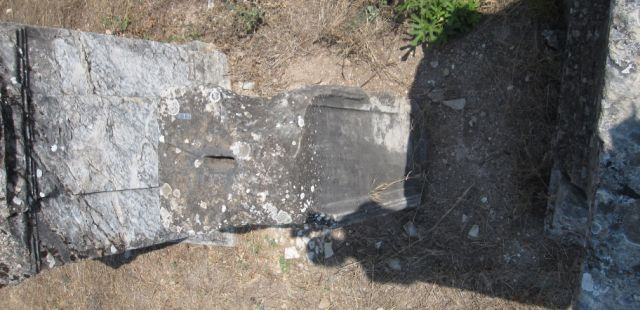
The shaft is intact but has a large chip in the top proper right of the late antique side as well as chips in the moulding. Projecting mouldings frame finished panels on all four sides. The top surface has a lewis hole and a pour channel.
On the front side is a high-imperial inscription of the late second or early third century which began on an upper element and entirely fills the panel. (IAph = http://insaph.kcl.ac.uk/iaph2007>, at 5.204)
The back side has simplified and irregular mouldings. The moulding on the proper left is more bevelled. It features a late inscription that begins and ends with a cross.
PROVENANCE AND CURRENT LOCATION
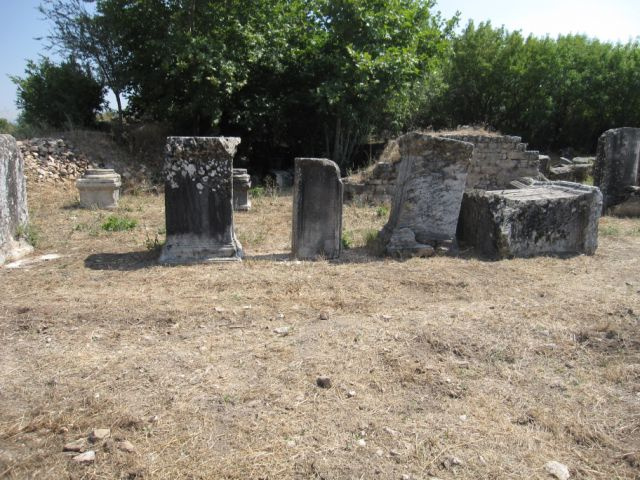
Excavated in 1905 in the forecourt on the east side of the Hadrianic Baths. It currently stands between pedestals in the southernmost line of the south half of the forecourt. The late antique side of the base faces south, away from the forecourt and toward a series of less-well explored rooms.
HONORAND, AWARDER AND DATE
The short inscription gives no indication of Hermias ever having held an official post in central government; thus, he was probably a rich local man. The text is furthermore vague as to what his real contribution to the Baths was. Roueché has suggested that his large monetary contribution was for the heating of the Baths which was a recorded source of difficulty under Justinian.
On the basis of the verse and the lettering, Roueché places the base in the late fifth to sixth century. In both of these aspects it is similar to another honour for a local man named John, LSA-230.
Cite: Last Statues of Antiquity, LSA-192 (J. Lenaghan).