
LSA-193
Base for statue of Fl. Eutolmius Tatianus, re-erected by his descendant. Aphrodisias (Caria). Earlier fifth century.
Record details
Photographs
Inscription
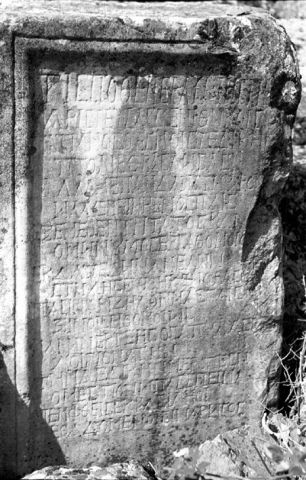
τίς; πόθεν; ἐκ Λυκίης μέ[ν], / ἀριστεύσας δ' ἐνὶ θώκοις / Τατιανὸς θεσμοῖς τε δίκης / πτολίεθρα ξαώσας. / (5) ἀλλά με πανδαμάτωρ χρόν[ος] / ὤλλυεν, εἰ μὴ ἐμὸς παῖς / ἐξ ἐμέθεν τρίτατος καὶ / ὁμώνυμος ἔργα θ' ὅμοιο[ς] / ἐκ δαπέδων ἀνελὼν /(10) στήλης ἔπι θῆκεν ὁρᾶσθ[αι] / πᾶσιν ἀριζηλον ναέταις / ξίνοισει θ' ὁμοίως / Καρῶν ἐκ γέης ὃς ἀπήλασε / λοίγιον ἄτην / (15) τὴν δὲ δίκην μερόπεσιν / ὁμέστιον ὤπας ἐπεῖναι / πεμφθεὶς ἐκ βασιλῆος / ἔθ' ἁδομένοισιν ἀρωγός.
Inscription translation
Who is this? From where? (I am) Tatianus from Lycia, who held the highest offices, and by just laws saved cities. But all-conquering time would have destroyed me if my child, of the third generation, who has the same name and similar achievements, had not lifted me up from the ground and set me on a monument, to be seen and admired by all, local inhabitants and strangers alike. (It is) he who drove deadly ruin from the land of the Carians, and gave justice to dwell among men, when he had been sent from the emperor as a defender for the people, who still rejoice.
(Trans: C. Roueché)
Bibliography
- Roueché, C., Aphrodisias in Late Antiquity (Journal of Roman Studies Monograph 5), London 1989, no. 37
Discussion
INSCRIPTION
Verse inscription of nine hexameters, laid out in 18 lines:
τίς; πόθεν; ἐκ Λυκίης μέ[ν], / ἀριστεύσας δ' ἐνὶ θώκοις /
Τατιανὸς θεσμοῖς τε δίκης / πτολίεθρα ξαώσας. /
(5) ἀλλά με πανδαμάτωρ χρόν[ος] / ὤλλυεν, εἰ μὴ ἐμὸς παῖς /
ἐξ ἐμέθεν τρίτατος καὶ / ὁμώνυμος ἔργα θ' ὅμοιο[ς] /
ἐκ δαπέδων ἀνελὼν /(10) στήλης ἔπι θῆκεν ὁρᾶσθ[αι] /
πᾶσιν ἀριζηλον ναέταις / ξίνοισει θ' ὁμοίως /
Καρῶν ἐκ γέης ὃς ἀπήλασε / λοίγιον ἄτην /
(15) τὴν δὲ δίκην μερόπεσιν / ὁμέστιον ὤπας ἐπεῖναι /
πεμφθεὶς ἐκ βασιλῆος / ἔθ' ἁδομένοισιν ἀρωγός.
'Who is this? From where? (I am) Tatianus from Lycia, who held the highest officies, and by just laws saved cities. But all-conquering time would have destroyed me if my child, of the third generation, who has the same name and similar achievements, had not lifted me up from the ground and set me on a monument, to be seen and admired by all, local inhabitants and strangers alike. (It is) he who drove deadly ruin from the land of the Carians, and gave justice to dwell among men, when he had been sent from the emperor as a defender for the people, who still rejoice.' (Trans: C. Roueché)
Letter height 3 - 4.5 cm.
DESCRIPTION
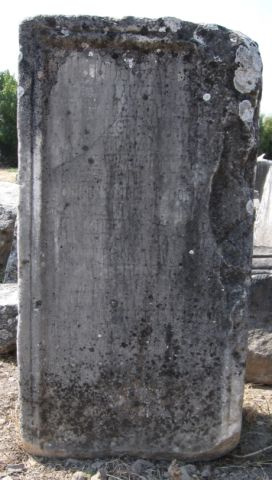
Rectangular base. H: 122, W: 58, D: 49 cm. White marble.
The shaft is intact but is heavily weathered and covered with lichen growth. It has large chips in the lateral (viewer’s right) mouldings of the front panel and a broken area at the top at the back left.
The back has been left roughly picked. There is a clamp cutting on the left side which continues onto the top surface. On the right side there is a depression in the middle of the top edge which may also be the remains of a clamp cutting.
PROVENANCE AND CURRENT LOCATION
Excavated in 1905 in the forecourt east of the Hadrianic Baths. It stood until 2011 in situ in front of the southeasternmost pedestal of the forecourt. It was until then standing on another which may have been its lower plinth.
HONORAND, AWARDER AND DATE
The honorand, Tatianus from Lycia, is Flavius Eutolmius Tatianus, the praetorian prefect of the East in 388 who suffered a damnatio in 392. He had erected statues for Valentinian II LSA-166, Arcadius LSA-164, and Honorius LSA-167 at Aphrodisias; for Valentinian II, Theodosius I, Arcadius, and Honorius, at Antinopolis (LSA-876) and at Side (LSA-267). His career is fully recorded in an inscription from Sidyma in Lycia (LSA-674).
The precise identity of the dedicator Tatianus is less clear. He was probably the governor of Caria given the references in the verse to imperial mission and justice.
He was either the grandson or great-grandson of Fl. Eutolmius Tatianus and was probably governor of Caria before the middle of the fifth century. Several men named Tatianus, probably related to the PPO of 388, some possibly the same, are referred to by different sources. (1) Libanius in a letter of 388 mentions a grandson named Tatianus (son of a daughter) who was sent to his grandfather. (2) In 440s Aeilia Eudocia calls a Tatianus a poet in the preface to the Homerocentrones. (3) Marcian appointed a Tatianus from Sidyma prefect of Constantinople; this Tatianus held that post between 450-452. (4) A patricius Tatianus went on a mission to the Vandals in 464 and was consul in 466.
Cite: Last Statues of Antiquity, LSA-193 (J. Lenaghan).