
LSA-1931
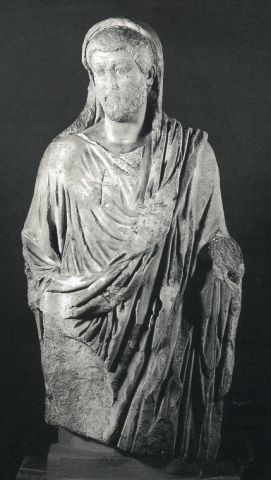
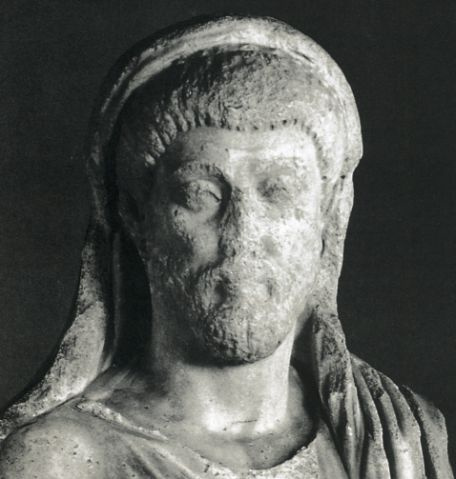
Togate portrait statue of man with hair and beard cut down. From Italica. Late third century.
Record details
Photographs
Bibliography
- García y Bellido, A., Catálogo de los retratos romanos. Museo Arqueológico Provincial de Sevilla, Madrid 1951, 21-2, no. 20
- Leon, P. , Esculturas de Italica, Andalucía 1995, 70-71, no. 17
Discussion
DESCRIPTION (Object)
Upper part of over life-size statue. H: 130 cm. H (head with neck): 34 cm. H (chin to crown): 27 cm. Parian marble
The statue is broken through the thighs. The forearms are missing; they were separately worked. There is a large chip over the front of the right thigh and smaller chips in various folds. The face is abraded, and the nose is mainly missing. A large cross has been engraved on the right chest.
The head has been re-cut from an earlier portrait. The original portrait had longer hair and a fuller beard. Here the surface of the hair has been taken down roughly and drill channels have been cut into the hair on the brow. The beard also seems reduced. The crease in the brow and the high arching eyebrows seem to belong to the second use.
The pupils seem to have been drilled. The folds of the toga are competently rendered and feature deep drillwork typical of the second century.
PROVENANCE
No specific location within Italica is noted by Leon.
DESCRIPTION (Subject)
The statue represents a mature man dressed in a tunic and toga which is covers the back of the head and is without an umbo. The right arm extends away from the body and probably held a patera. The left arm is bent and rests alongside the body; it supports the end of the toga.
The head turns to its right and shows a man with full hair, moustache, and beard. The beard is cropped close to the cheeks. The hair has a uniform volume and thus sits like a cap. The hairline comes forward at the centre of the brow. Short thick locks are indicated in the hair which frames the face.
The face is long with a broad brow and wide-set cheekbones. The brow has a crease which echoes the undulation of the hair framing it. The eyebrows have a high arch, and the eyelids are heavy. The chin appears long because of the thickness (though reduced from that of the original portrait) of the beard which covers it..
DATE
The portrait head has been re-cut to portray a man with short hair, a creased forehead, and a beard. This is the fashion style of the late third century.
The original portrait, which seems to have featured full hair, full beard, drilled eyes, and heavy eyelids, probably belonged to the Antonine period (see, Garcia y Bellido). Goette dates the toga to the Hadrianic period mainly because of the lack of umbo.
Discussion references
- Goette, H.R., Studien zu römischen Togadarstellungen, Mainz 1990, 56 and 141, no. Ca 10, pl. 31.2 (Hadrianic)
Cite: Last Statues of Antiquity, LSA-1931 (J. Lenaghan).