
LSA-1934
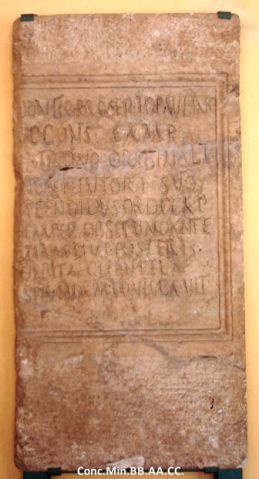
Plaque from base of statue of Pontius Proserius Paulinus, governor of Campania and patron of Capua. Beneventum (Campania). 409.
Record details
Photographs
Inscription
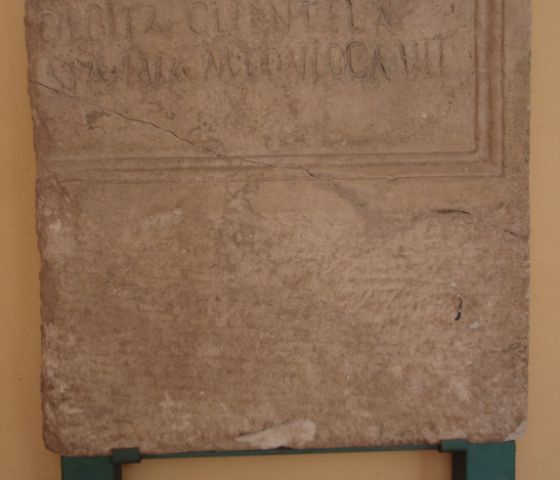
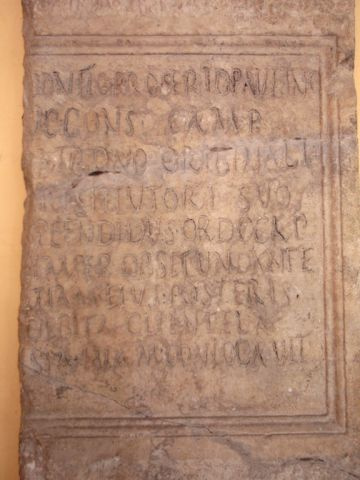
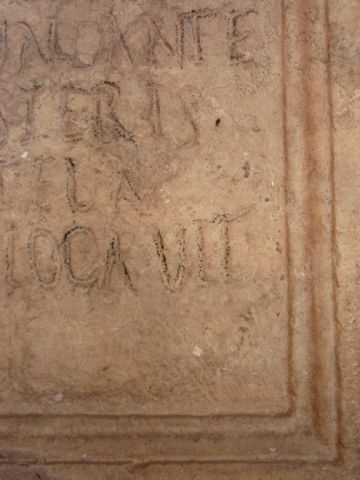
Pontio Proserio Paulino, / v(iro) c(larissimo), cons(ulari) Camp(aniae), / [p]atrono originali, / restitutori suo /(5) splendidus ordo Cap(uensis) / semper obsecundante / etiam eius posteris / debita clientela / statuam conlocavit.
Inscription translation
To Pontius Proserius Paulinus, of clarissimus rank, governor (consularis) of Campania, patron by descent; the council (ordo) of Capua, always yielding to their restorer and even to his descendants, in due clientship, set up this statue.
Bibliography
- Camodeca, G., "Fabius Maximus e la creazione della provincia del Samnium", Atti dell'Accademia di Scienze Morali e Politiche di Napoli, 82, 1971, 261-4
- L'Année épigraphique, , 1972, 143;
Discussion
INSCRIPTION
In nine lines:
Pontio Proserio Paulino, / v(iro) c(larissimo), cons(ulari) Camp(aniae), / [p]atrono originali, / restitutori suo /(5) splendidus ordo Cap(uensis) / semper obsecundante / etiam eius posteris / debita clientela / statuam conlocavit.
‘To Pontius Proserius Paulinus, of clarissimus rank, governor (consularis) of Campania, patron by descent; the council (ordo) of Capua, always yielding to their restorer and even to his descendants, in due clientship, set up this statue.‘
Letter height
DESCRIPTION (from Camodeca 1971 and the published image)
Marble plaque, H 147, W 74.5, D 7 cm. The plaque has a framed epigraphic field in its centre; the area around the epigraphic field is worked back.
PROVENANCE AND CURRENT LOCATION
The inscription was found in 1956 during works at Piazza di Corte in Benevento. The record of the awarder, the city council of Capua (line 5) strongly suggests that it was originally from Capua (see below, ‘Further Discussion‘).
The inscription is now in the Museo del Sannio, Benevento, Lapidario del Chiostro di Santa Sofia, inv. 748
HONORAND, AWARDER AND DATE
Pontius Proserius Paulinus, the honorand, was of senatorial (clarissimus) rank (PLRE II, 848-9 Pontius Proserius Paulinus 16). He was governor (consularis) of Campania (line 2) and patron of the awarding city Capua (line 3). He is on record with further statues, all in Campania: he was honoured in Puteoli (LSA-339) and possibly in Formia (LSA-2045), and he set up an inscription in Abellinum (LSA-1862) (’see also below, Further Discussion’).
Paulinus time in office as governor of Campania was probably 409; this is suggested by the Abellinum inscription (see above, last paragraph) – we adopt this date for Paulinus, although his name is blurred in that inscription (see discussion there).
The inscription was set up by the council of Capua, styled splendidus ordo (line 5).
FURTHER DISCUSSION
Paulinus is styled originalis patronus in our inscription (line 3). Similar formulae are often used in late antiquity; they possibly refer to family relations with the city, but do not necessarily mean that the honorand was a native of the city or region (cf. e.g. LSA-339 set up to Paulinus in Puteoli, and LSA-272 and LSA-1936, both to Sextus Claudius Petronius Probus).
The inscription was found in Benevento; however, it was probably brought there from Capua. It is highly unusual that civic institutions honour persons in the public space of another city; the only remotely comparable case I am aware of is LSA-153 where a governor, probably of Phrygia, is honoured in his hometown, Aphrodisias in Caria.
On the identity of Paulinus see also discussion under LSA-2045.
Discussion references
- Jones, A. H. M. et al., The Prosopography of the Later Roman Empire. Vol. I 260-395, Cambridge et al. 1971 (1975), 848-9
Cite: Last Statues of Antiquity, LSA-1934 (preliminary version, discussion added 4/15 (Gehn / Machado)).