
LSA-1935
Base for statue of Brittius Praetextatus, governor of Byzacena; erected by the city of Hadrumetum (in Byzacena). Capua (Campania). 330-395.
Record details
Photographs
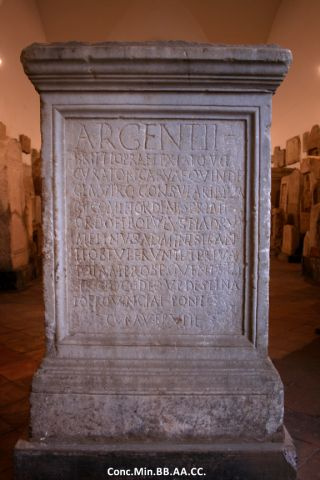
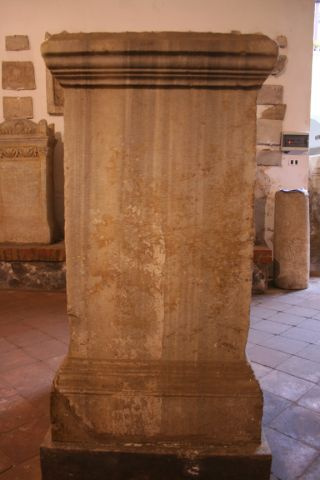
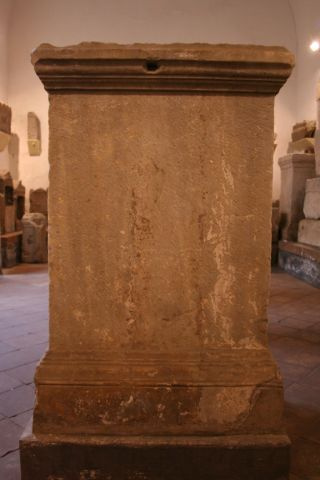
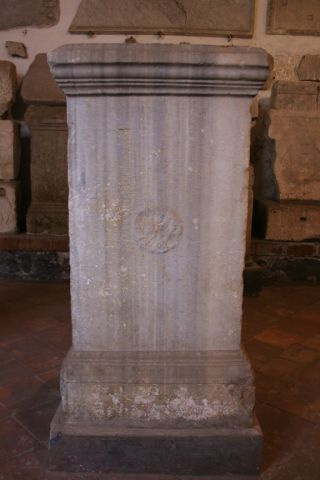
Inscription
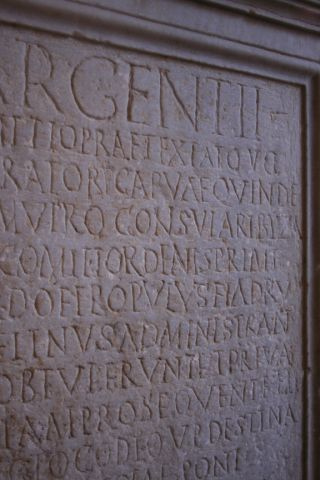
Argentii./ Brittio Praetextato, v(iro) cl(arissimo),/ curatori Capuae, quinde/cemviro, consulari Byza/cii, comiti ordinis primi,/ ordo et populus Hadru/metinus administran/ti obtulerunt et, priva/to iam, prosequente Fl(avio)/ Sergio Codeo v(iro) p(erfectissimo), destina/to provinciae, poni / curaverunt.
Inscription translation
[Statue of] Argentius. To Brittius Praetextatus, of clarissimus rank, curator of Capua, member of the priestly board of 15 men, governor (consularis) of Byzacium, count of the first order; the council (ordo) and the people of Hadrumetum offered [this statue] when he was in office and, when [Praetextatus] had retired from office (privato iam), oversaw its setting up, attended by Flavius Sergius Codeus, of perfectissimus rank, sent by the province.
Bibliography
- Corpus Inscriptionum Latinarum; , X, 3846
- Chioffi, L., Museo Provinciale Campano di Capua. La Raccolta Epigrafica, vol. I, Capua 2005, 14
Discussion
INSCRIPTION
In twelve lines:
Argentii./ Brittio Praetextato, v(iro) cl(arissimo),/ (3) curatori Capuae, quinde/cemviro, consulari Byza/cii, comiti ordinis primi,/ (6) ordo et populus Hadru/metinus administran/ti obtulerunt et, priva/to iam, prosequente Fl(avio)/(10) Sergio Codeo v(iro) p(erfectissimo), destina/to provinciae, poni / curaverunt.
’[Statue of] Argentius. To Brittius Praetextatus, of clarissimus rank, curator of Capua, member of the priestly board of 15 men, governor (consularis) of Byzacium, count of the first order; the council (ordo) and the people of Hadrumetum offered [this statue] when he was in office and, when [Praetextatus] had retired from office (privato iam), oversaw its setting up, attended by Flavius Sergius Codeus, of perfectissimus rank, sent by the province.’
Letter height 3-8 cm.
DESCRIPTION (from Epigraphic Database Roma (EDR), Chioffi 2005, and our own photos)
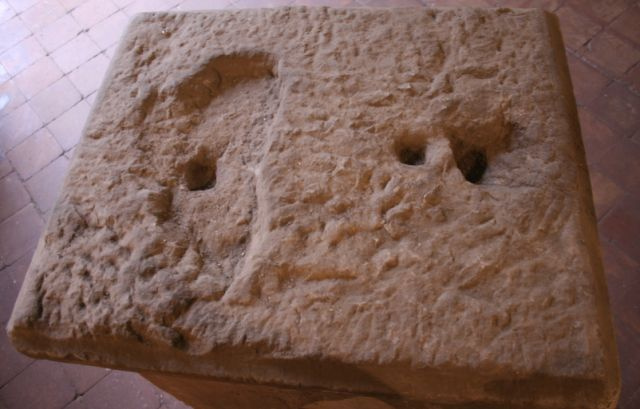
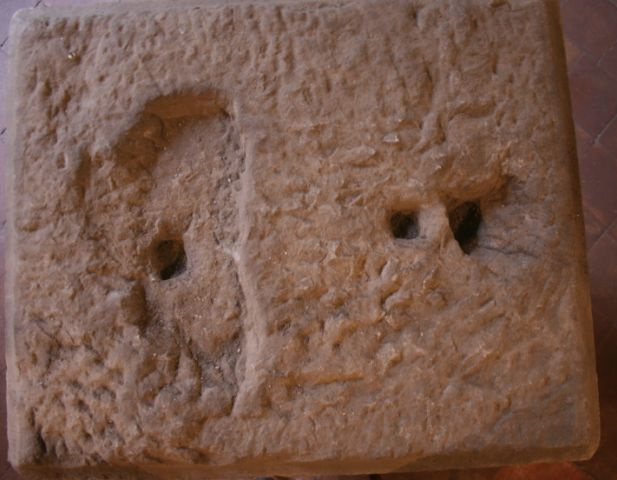
Rectangular marble base moulded at top and bottom; H 134, W 86, D 72 cm. The epigraphic field is framed. The top face is roughly finished and has imprints from a bronze statue. There are remains of a sacrificial bowl (patera) standing proud in relief at the right side; this suggests that our base was an altar (arula) in its original use.
PROVENANCE AND CURRENT LOCATION
The inscription was first recorded in Capua in a private house (in aedibus Argentianis) by the French scholar Jacques Sirmond (Jacobus Sirmondus) in the late 16th/ early 17th century. It was recorded in the Bourbon prison, then transformed into barracks of the artillery, by Mommsen for CIL X in 1883.
The inscription is now in Capua, Museo Campano, Sala Mommsen, no. 203.
HONORAND, AWARDER AND DATE
Brittius Praetextatus signo Argentius, the honorand, was of senatorial (clarissimus) rank (PLRE I, 724 Brittius Praetextatus signo Argentius 2). He was curator rei publicae of Capua (line 3) and member of the senatorial priestly board of quindecimviri sacris faciundis (lines 3-4). He was governor (consularis) of Byzacene (lines 4-5), and held the court office of count of the first order (comiti ordinis primi, line 5). The three grades of comites were instituted in 330; this is the terminus post quem for our inscription. Brittius Praetextatus is one of the last curators of senatorial rank; this office was usually held by men of lower perfectissimus rank in the mid- and later 4th century (Ausbüttel 1988, 30). PLRE suggested a terminus ante quem of c. 395 ‘on account of his priesthood’.
Our inscription was set up by the city of Hadrumetum (ordo et populus Hadrumetinus, lines 6-7) in Byzacena. The inscription informs us that the city had offered the statue when Praetextatus was still in office as provincial governor (administranti obtulerunt, lines 7-8); however, it was realized only when he had retired from this office (privato iam, lines 8-9) and returned to Capua, probably his hometown.
The dedication of the statue was supervised by an envoy of the province, Flavius Sergius Codeus, a man of high equestrian (perfectissimus) rank (PLRE I, 217 Fl. Sergius Codeus).
FURTHER DISCUSSION
Statues by provincials in the honorand’s hometown are mostly known from Rome; a similar case in a provincial city is known from Barcino (LSA-1989).
Discussion references
- Ausbüttel, F.M., Die Verwaltung der Städte und Provinzen im spätantiken Italien, Frankfurt/ Main 1988, 30
- Jones, A. H. M. et al., The Prosopography of the Later Roman Empire. Vol. I 260-395, Cambridge et al. 1971 (1975), 217. 724
Cite: Last Statues of Antiquity, LSA-1935 (preliminary version, discussion added 4/15 (UG)).