
LSA-1937
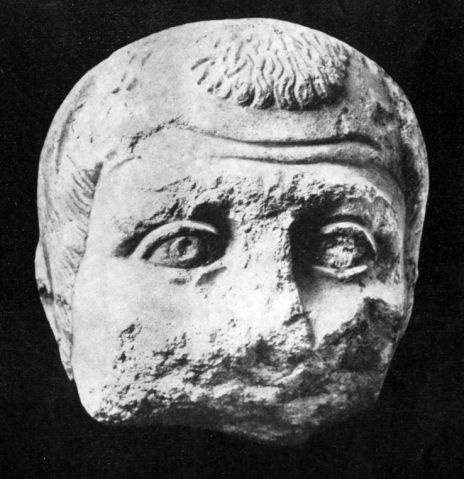
Upper part of portrait head of clean-shaven man. Constantia (Tomis). (Scythia). Mid fourth century.
Record details
Photographs
Bibliography
- Bergmann, M., Studien zum römischen Porträt des 3. Jahrhunderts n. Chr., Bonn 1977, 160, fn. 656, pl. 46.6
- Canarache, V., The mosaic-floored edifice of Tomi = Edificiul cu mozaic din Tomis, Constanta 1967, discussion with unnumbered illustration
Discussion
DESCRIPTION (Object)
The head is broken below the nose, a portion of the right cheek and the largest part of the left are damaged. The nose is broken, the root of the nose and the eyebrows chipped off; there are further chips on the left eye and on the brow. No measurements have been published so far.
The hair is marked by fine chisel lines, wavy above the brow and straight at the temples. It is plastically set off the flesh but fringes out into fine locks around the face. Above the center of the brow the locks are parting.
The brow is furrowed by two horizontal lines; at the root of the nose two short vertical lines are still recognizable. The uppermost of the horizontal furrows marks the edge of what must have been the hairline in an earlier use of the head; the outline would most readily fit a late-3rd century hairstyle.
The iris was circumscribed by an incised line, as visible on the better preserved right eye; the pupil is a large shallow hole in the center of the eyeball.
Bergmann 1977 quotes an information by the Constanţa Museum that the head probably belonged to a bust; no archaeological record has been published that could verify this assumption.
PROVENANCE AND MOST RECENTLY RECORDED LOCATION
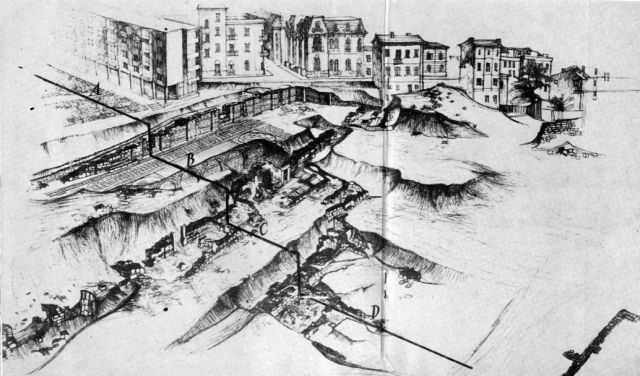
The head was found in 1959/62 during the excavations of the so-called mosaic-floored edifice of Tomi, a large building of commercial and public use in four terraces (Canarache 1967). The third terrace (B) included a vast room lavishly decorated with mosaic floor and marble veneer, dated to the Constantinian period by coins of Constantine I and Constantius II found at several spots in the mortar foundation of the mosaic (Canarache 1967, 8). Our head was found in the first layer of archaeological material on top of the mosaic floor; it probably once formed part of the accoutrement of that room.
The head is today in the Constanţa Museum, without published inv. no.
DESCRIPTION (Subject)
The portrayed is a man of mature age as indicated by the furrows on his brow and the bolding head. His hair is short and brushed forward; it forms a convex line above the brow and is heavily receding above the temples. The eyes are wide open; together with the furrows they signal alertness and concern. The bolding head is probably an individualizing feature.
HONORAND AND DATE
The head was assigned to the ‘tetrarchic type’ by Bergmann 1977 mainly on base of the expressively furrowed brow. The find spot suggests that it was used (and probably re-carved, see above, ‘Description (Object)’) in the Constantinian era. Forward brushed hair with singled out locks above the brow can be seen on portraits of the later tetrarchic period (Dresden-Stockholm type, LSA-895, LSA-896, LSA-897); the arrangement of the hair into wavy strands, however, finds its best parallels in portraits of Constantine I and his sons (LSA-554, LSA-557, LSA-752, LSA-753, LSA-902, LSA-899, LSA-2288, LSA-2289).
This is possibly an imperial portrait of the late tetrarchic period.
If a Constantinian date is accepted, then the receding hair and the furrowed face would identify the head as a non-imperial portrait. After the introduction of the clean-shaven, long-haired imperial portrait type by Constantine I, non-imperial portraits of the mid and later 4th century usurp iconographic features which in the tetrarchic period signalled the labor and cura of the emperors, like furrowed brows and the trimmed hair and beard of the 'man on campaign'.
Cite: Last Statues of Antiquity, LSA-1937 (Ulrich Gehn).