
LSA-1938
Base for statue (subject unstated), erected by Virius Lupus Victorius, governor of Campania. Capua (Campania). Fourth to earlier fifth century.
Record details
Photographs
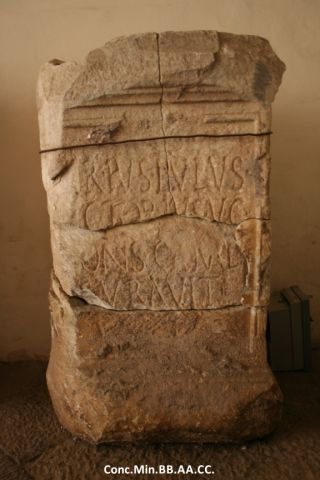
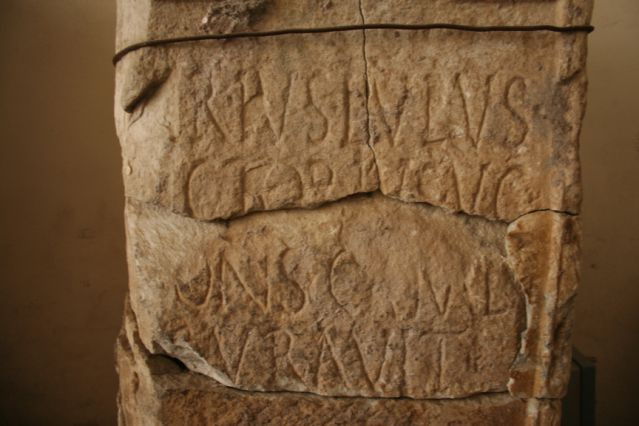
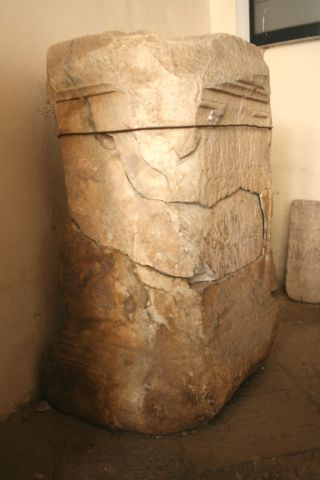
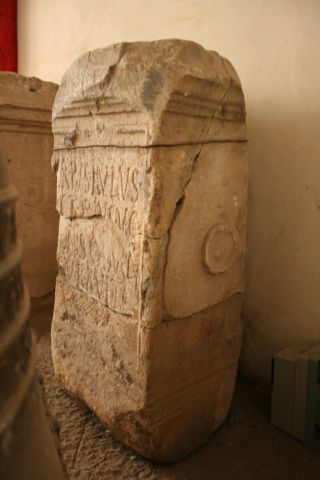
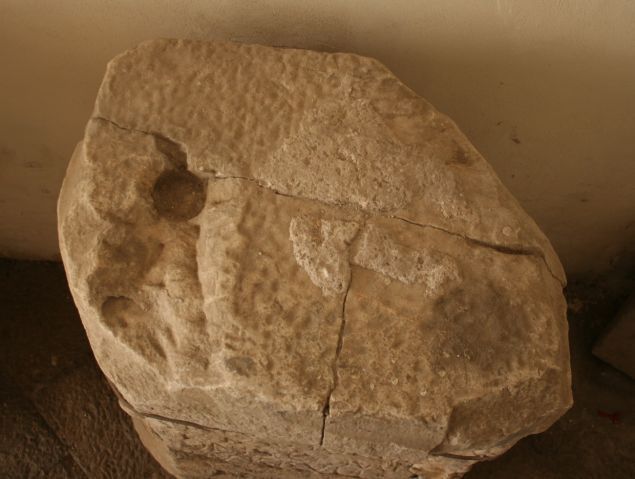
Inscription
[V]irius Lupus / [V]ictorius, v(ir) c(larissimus), / [c]ons(ularis) Camp(aniae), / curavit.
Inscription translation
[V]irius Lupus / [V]ictorius, v(ir) c(larissimus), / [c]ons(ularis) Camp(aniae), / curavit.
Bibliography
- Chioffi, L., Museo Provinciale Campano di Capua. La Raccolta Epigrafica, vol. I, Capua 2005, 113
- L'Année épigraphique, , 1978, 114
Discussion
INSCRIPTION
In four lines:
[V]irius Lupus / [V]ictorius, v(ir) c(larissimus), / [c]ons(ularis) Camp(aniae), / curavit.
’[V]irius Lupus / [V]ictorius, of clarissimus rank, governor (consularis) of Campania, took care.’
Letter height 7-9 cm.
DESCRIPTION (from Chioffi 2005, and our images)
Rectangular limestone base with mouldings at top and bottom, H 110, W 63, D 50 cm. Both mouldings are heavily damaged. The base is broken twice horizontally, at line 2 and below line 4 of the inscription. There is a vertical break running through the upper portion of the base. The inscription is carved over an erased earlier one; this is still visible at lines 3-4.
PROVENANCE AND CURRENT LOCATION
The inscription was found in Capua in 1959 (see also below, ’Further Discussion’).
It is now in the Museo Provinciale Campano di Capua, Androne secondario, no. 36.
HONORAND, AWARDER AND DATE
Virius Lupus Victorius, the awarder, was of senatorial rank (PLRE I, 522-3 Virius Lupus signo Victorius 7). He was governor (consularis) of Campania (line 3). The rank of the governor of Campania was upgraded from corrector to consularis in 314/24 (PLRE I, 1092 Fasti); this is a safe terminus post quem for our inscription. There is some uncertainty about Lupus‘ name and identiy. I do not see any conclusive argument to suggest a narrow date for Virius Lupus Victorius time in office, and I therefore suggest broad outer dates in the 4th or earlier 5th century (but see below, ‘Further Discussion‘, for some considerations).
Virius Lupus Victorius is possibly identical to the governor Virius Lupus recorded on another, similar inscription from Capua (LSA1939; see also below, ‘Further Discussion‘).
The subject of the dedication is not made explicit by our inscription. As in similar cases, it was possibly a mythical figure (a deity or a hero), or an emperor of the earlier imperial period (see LSA-1240).
FURTHER DISCUSSION
There is some uncertainty about Lupus‘ name and identiy. PLRE suggested that Victorius was a signum. PLRE also tentatively considered his identity with Victorius the governor (proconsul) of Africa of 398 who is known from Codex Theodosianus I, 12, 6a and IX, 39, 3a (PLRE I, 965 Victorius 3) (see next paragraph).
If our man is identical to the proconsul of Africa of 398, Victorius should be considered a regular name of his; officials were not addressed with their signum in official texts as law texts (Cameron 1985). In other words, if Victorius was our man’s signum, then he would have been addressed Lupus in a law text and could not be identical to the proconsul Africae of 398.
While the identity of our man to the proconsul Africae of 398 remains possible, he is certainly identical to [---]us Lupus Vict[---], [consular]is Camp[aniae] on a mutilated inscription from Praeneste (CIL XIV, 2928). This inscription, however, does not help to narrow the date of Virius Lupus Victorius‘ time in office in Campania, or to further clarify his identity.
A similar if mutilated inscription from Capua records a governor of Campania Virius Lupus (LSA-1939). It is possible that this Virius Lupus is identical to our man, and that either the signum Victorius was omitted in that inscription, or that this part of his name, whether signum or not, is lost.
If we consider Victorius to be a signum, it is possible that our man is identical to Lupus, governor (consularis) of Campania under Julian (361-3) recorded by Symmachus, relatio 40. 3. 5 (Divo Iuliano moderante rem publicam, cum Lupus consulari iure Campaniae praesideret - ‘when the deified Julian guided the state, and when Lupus administered Campania with consular authority‘) (PLRE I, 521 Lupus 1). Another possibility is his identity to Virius Lupus, the governor (proconsul) of Africa known from a dedication to Constantius II (337-61) in Carpis (LSA-1838; PLRE I, 522 Virius Lupus 6). Nothing else is known about this Lupus, and it is well possible that he held the governorship in Campania before he was promoted to the higher rank of proconsul of Africa.
To sum up, it is perfectly possible that our Virius Lupus Victorius is identical to one of the office holders quoted above. It cannot be excluded, however, that he was another man of a similar name, and of a later period.
It is possible that our inscription is identical to LSA-1939 (so Chioffi 2005, 111); or this is a similar inscription set up by the same man, or by a man with a similar name ( for a more detailed discussion of this issue see LSA-1939).
Discussion references
- Corpus Inscriptionum Latinarum; , XIV 2928
- Cameron, Al., Polyonomy in the Late Roman Aristocracy: the Case of Petronius Probus, Journal of Roman Studies 75, 1985
- Jones, A. H. M. et al., The Prosopography of the Later Roman Empire. Vol. I 260-395, Cambridge et al. 1971 (1975), 522-3
Cite: Last Statues of Antiquity, LSA-1938 (preliminary version, discussion added 4/15 (UG)).