
LSA-194
Columnar base for statue of Rhodopaeus. Aphrodisias (Caria). Sixth century.
Record details
Photographs
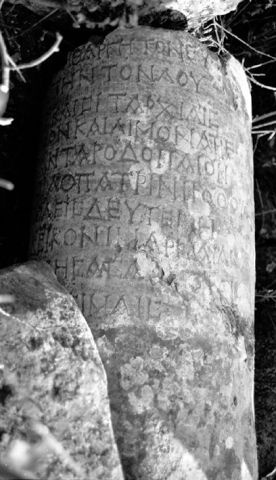
Inscription
τὸν ἀ]ληθάργητον εὐ/[ερ]γέτην τὸν λου/[τ]ροῖς καὶ σιταρχίαις / λοιμὸν καὶ λιμὸν ἀπε/λάσαντα Ῥοδοπαῖον / [τ]ὸν φιλόπατριν ποθοῦ/[σ]α πόλ<ε>ις δευτέρῃ / [τ]ῇδ' εἰκόνι μαρμάραι / κοσμήσασα ἀξίαις / [ἡ]μείψατο τιμαῖς.
Inscription translation
The never-to-be-forgotten benefactor, who, with baths and with command of the corn-supply, drove away plague and famine, Rhodopaeus, lover of his country; the city, loving him, has adorned him with this second marble image, repaying him with worthy honours.
(Trans: C. Roueché)
Bibliography
- Roueché, C., Aphrodisias in Late Antiquity (Journal of Roman Studies Monograph 5), London 1989, no. 86
Discussion
INSCRIPTION
[τὸν ἀ]ληθάργητον εὐ/[ερ]γέτην τὸν λου/[τ]ροῖς καὶ σιταρχίαις /(4) λοιμὸν καὶ λιμὸν ἀπε/λάσαντα Ῥοδοπαῖον / [τ]ὸν φιλόπατριν ποθου/[σ]α πόλ<ε>ις δευτέρῃ / [τ]ῇδ' εἰκόνι μαρμάραι / κοσμήσασα ἀξίαις /(10) [ἡ]μείψατο τιμαῖς. cross
'The never-to-be-forgotten benefactor, who, with baths and with command of the corn-supply, drove away plague and famine, Rhodopaeus, lover of his country; the city, loving him, has adorned him with this second marble image, repaying him with worthy honours.' (Trans: C. Roueché)
Letter height 2-4 cm.
DESCRIPTION (Object)
Column shaft. H: 114, W: 48, D: 42 cm. White marble.
The shaft is broken at the top and has a chip at the end of line 7 which continues downward and to the viewer’s right. It is heavily weathered and covered with lichen growth
PROVENANCE AND CURRENT LOCATION
Found by Gaudin in the forecourt to the east of the Hadrianic Baths. It remains in situ in the southern half of the forecourt, on the inside of the eastern colonnade, in between pedestals two and three (counting from north to south).
HONORANDAND DATE
The honorand is the same Rhodopaeus who was honoured at Aphrodisias in LSA-188, also from the Baths, and LSA-233, the provenance of which is unknown.
From this inscription it is clear that he was a native of Aphrodisias and a benefactor who contributed to the Baths and who was involved in the corn supply. LSA-188 refers to him as a father which is the title of a local magistrate, and LSA-233 gives him the sole rank of magnificentissimus which had become common in the later fifth and sixth centuries. Roueché connects the emphasis on Rhodopaeus’ involvement with the food supply, mentioned again in LSA-233, as a reflection of the faminine of 541/2. She dates all three statues to the mid-sixth century.
Cite: Last Statues of Antiquity, LSA-194 (J. Lenaghan).