
LSA-1943
Possible base for statue of Turcia Marcella, senatorial woman. Capua (Campania). Probably third to fourth century.
Record details
Photographs
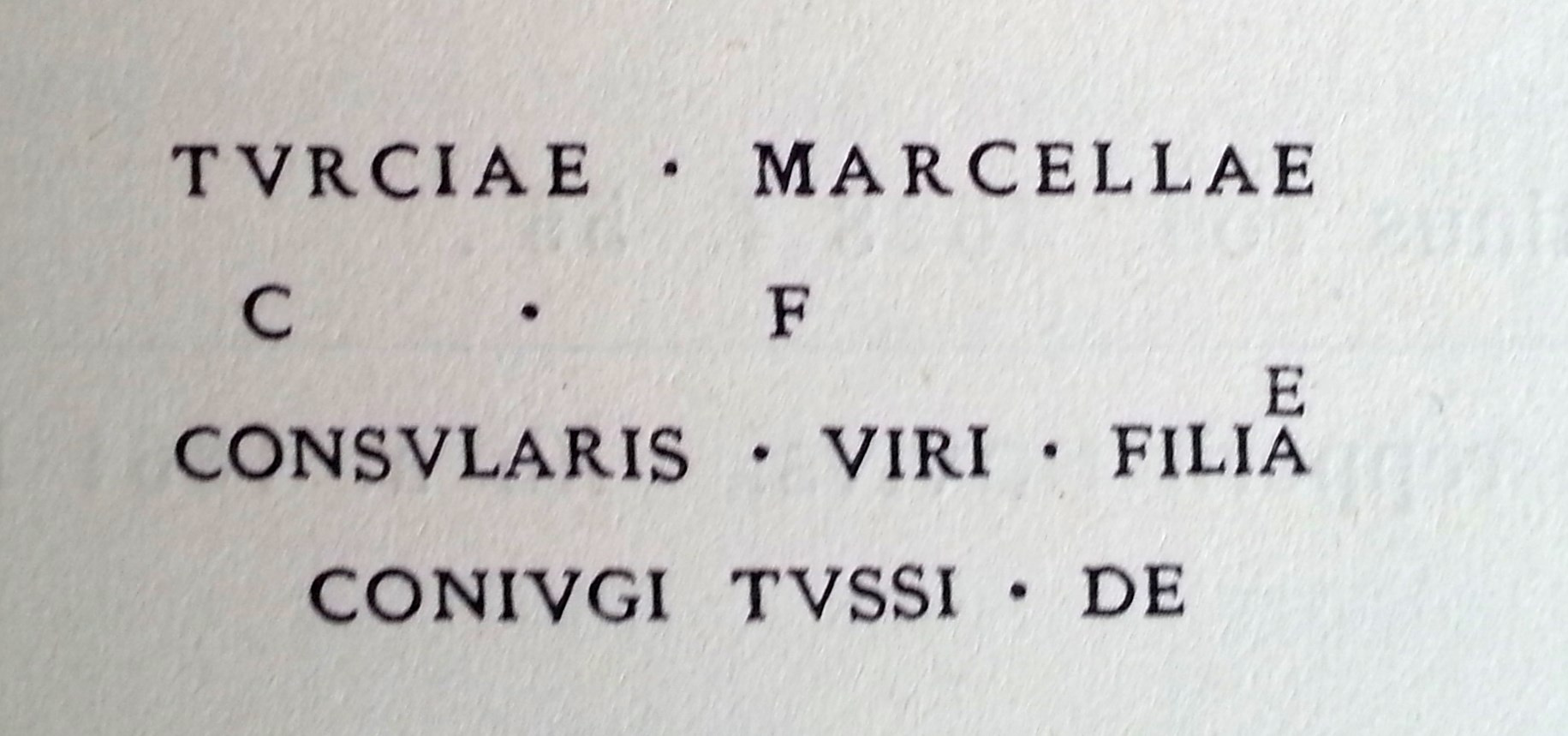
Inscription
Turciae Marcellae, / C(ai) f(iliae), / consularis viri filiae, / coniugi Tussi de(curionis).
Inscription translation
To Turcia Marcella, daughter of Caius, daughter of a man of consular rank, wife of Tussus, councillor.
Bibliography
- Corpus Inscriptionum Latinarum; , X, 3862
Discussion
INSCRIPTION
Four lines preserved:
Turciae Marcellae, / c(larissimae) f(eminae), / consularis viri filiae, / coniugi Tussidi(---) / .(---)
‘To Turcia Marcella, daughter of a man of consular rank, wife of Tussidius (?), (...).‘
Letter height not recorded.
We reproduce the inscription with the completions suggested by Andermahr 1998 and Epigraphic Database Roma (EDR) (L. Chioffi) (see also below, ‘Further Discussion‘).
The epigraphic formula with an honorand in the dative suggests that this was possibly a statue base inscription on which the final lines of the inscription recording the awarder are lost. However, this is not conclusive, and it is also possible that this was a funerary inscription (see below, ‘Description‘).
DESCRIPTION (from CIL)
CIL, the only modern publisher of our inscription, has no description of the block. No measurements are published, and there is no published image.
CIL suggested that the text was probably missing a portion at the bottom (see above, ’Inscription’, and below, ’Honorand, Awarder and Date’).
PROVENANCE AND CURRENT LOCATION
The inscription was recorded by the local scholar and clergyman Alexander Symmachus Mazochi in the mid-18th century, but without record of its location. Likewise in the 18th century the historian and clergyman Ludovico Antonio Muratori recorded the inscription in Sta. Maria Capua Vetere (ad Capuam veterem), the location of ancient Capua.
There is no recent record of its location.
HONORAND, AWARDER AND DATE
Turcia Marcella, the honorand, was of senatorial (clarissima) rank (PLRE I, 543 Turcia Marcella 3). She was the daughter of a consular man, that is a man who had held a consular office or was adopted into the senate with consular rank (adlectus inter consulares) (on consular rank and offices see Chastagnol 1982, 168-70; see also below, ’Further Discussion’). Her husband’s name is possibly mutilated on our inscription. He was possibly named Tussis or Tussidius and is otherwise unknown; he was possibly a local man.
The record of clarissima rank on inscriptions starts in the late 2nd century and is a common feature in the later 3rd and 4th century. Our inscription is probably of the 3rd or 4th century, but there there is no good evidence for a narrower date.
The awarder is lost on our inscription, or was never recorded (see above, ’Inscription’).
FURTHER DISCUSSION
Several members of the senatorial family of the Turcii (Turcii Secundi and Turcii Aproniani) are on record in our period (see PLRE I, 1147 stemma 29). Turcia Marcella was possibly the daughter of one of these; PLRE suggested Lucius Turcius Faesasius Apronianus (PLRE I p. 87 Apronianus 6). Apronianus is on record as consul suffect; however this office is not always recorded, and its absence in the record of other Turcii does not necessarily mean they did not hold it.
The 18th century historian Muratori, one of the first to record our inscription (see above, ‘Provenance and Current Location‘) suggested to complete coniugi Tussi de(curionis) in line 4. I think this is highly improbable; I could find no parallel for it and I think it was justly abolished by EDR. However, I quote it here because it is part of the attempts to understand this obscure inscription, and it might give a clue to someone else.
Discussion references
- Andermahr, A.M., Totus in praediis. Senatorischer Grundbesitz in Italien in der frühen und hohen Kaiserzeit, Bonn 1998, 454-5 no. 531
- Jones, A. H. M. et al., The Prosopography of the Later Roman Empire. Vol. I 260-395, Cambridge et al. 1971 (1975), 543
Cite: Last Statues of Antiquity, LSA-1943 (preliminary version, discussion added 4/15 (UG)).