
LSA-1949
Base for statue of Constantine II, emperor. Thuburbo Maius (Africa Proconsularis). 337-340
Record details
Photographs
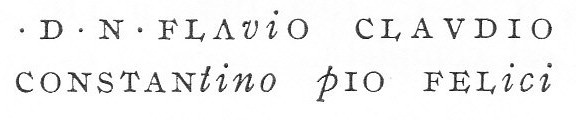
Inscription
D(omino) n(ostro) Flavio Claudio / Constan[tino, p]io, fel(ici), / victori, semper Aug(usto), / C[----], / (5) c[ol(onia) Iul(ia) Aur(elia) Com(moda)] T(h)ub(urbo) Ma/ius, [nu]m[ini eius de]vo[ta].
Inscription translation
To our lord Flavius Claudius Constantinus, pious, fortunate, victor, forever Augustus; the Julian, Aurelian, Commodan colony of Thuburbo Maius, devoted to his divine spirit, [set this up].
Bibliography
- Corpus Inscriptionum Latinarum; , VIII, no. 15267
- Lepelley, C., Les cités de l'Afrique romaine au Bas-Empire, t. 2, Notices d'histoire municipale, Paris 1981, p. 202-203, n. 17
- Merlin, A., Inscriptions latines de la Tunisie, Paris, 1944, no. 695
Discussion
INSCRIPTION
In six lines:
D(omino) n(ostro) Flavio Claudio / Constan[tino, p]io, fel(ici), / victori, semper Aug(usto), / C[----], / (5) c[ol(onia) Iul(ia) Aur(elia) Com(moda)] T(h)ub(urbo) Ma/ius, [nu]m[ini eius de]vo[ta].
'To our lord Flavius Claudius Constantinus, pious, fortunate, victor, forever Augustus, ... The Julian, Aurelian, Commodan colony of Thuburbo Maius, devoted to his divine spirit, [set this up].'
Thuburbo Maius is termed 'Aurelia Commoda' because it was given colonial status under Commodus. It is also designated 'Iulia', perhaps because, in the two first centuries AD, there was a settlement here (a pagus) of Roman citizens, as an off-shoot of the Julian colony of Carthage (as suggested H.-G. Pflaum).
DESCRIPTION (from Merlin, ILTun)
There are no published descriptions of this base, other than the statement that it was broken in two (with the top half built into a bridge), no measurements, and no published image.
PROVENANCE AND CURRENT LOCATION
The upper part of the base (lines 1-2) was identified re-used in a bridge on the road from Tunis, south of the ruins. There is no published record of the lower part's precise findspot. There is no recent published record of either part's subsequent location.
HONORAND, AWARDER AND DATE
The honorand, Constantine II, was Augustus from 337 to 340.
The awarder was the city, as usual for imperial statues in Africa.
Discussion references
- Pflaum, H.-G., 'La Romanisation de l'ancien territoire de Carthage punique à la lumière des découvertes épigraphiques récentes', Antiquités africaines, IV, Paris, 1970, p. 111-7
Cite: Last Statues of Antiquity, LSA-1949 (Gabriel de Bruyn).