
LSA-195
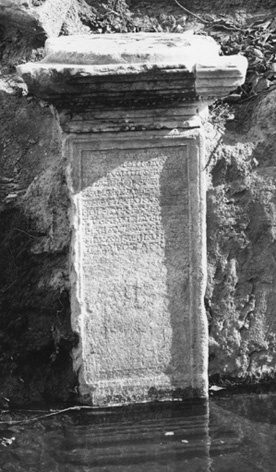
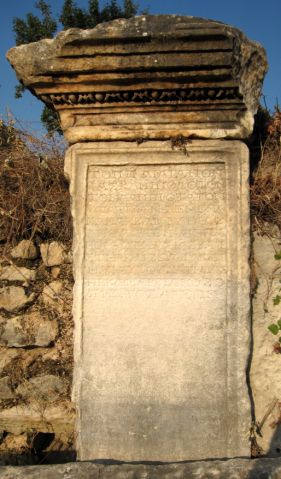
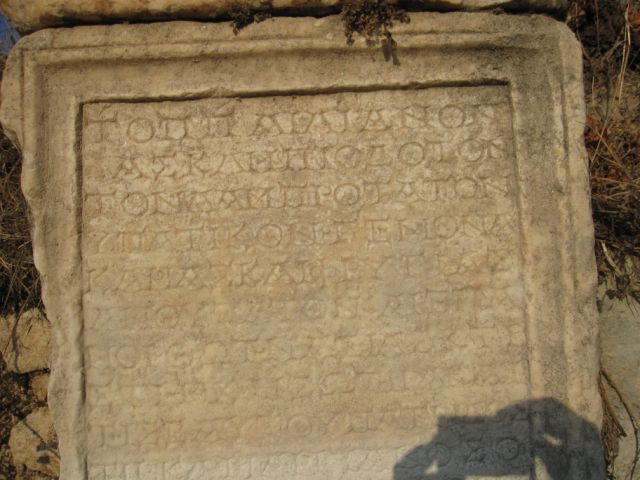
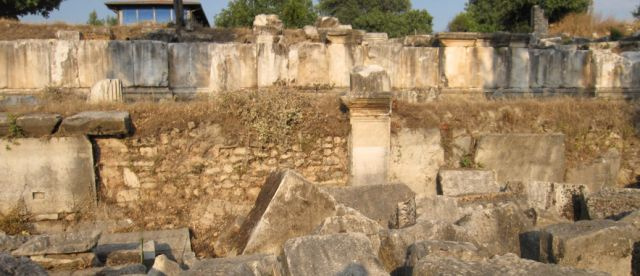
Base for statue of Titus Oppius Aelianus Asclepiodotus, governor of Asia. Aphrodisias (Caria). Late third century.
Record details
Photographs
Inscription
ἡ πατρὶς / Ἀγαθῇ Τύχῃ / Τ(ίτον) Ὄππ(ιον) Αἰλιανὸν / v. Ἀσκληπίοδοτον /(5) τὸν λαμπρότατον / ὑπατικὸν ἡγεμόνα / Καρίας καὶ Φρυγίας / ἀνθύπατον καὶ ἐπα/νορθωτήν Ἀσίας κτί/στην καὶ σωτῆρα καὶ /(11) τῆς ἑαυτοῦ πατρίδος / Τιβ(έριος) Κλ(αύδιος) Μαρκιανὸς ὁ / πρῶτος ἄρχων.
Inscription translation
The Homeland, With Good Fortune, (set up the statue of) T(itus) Opp(ius) Aelianus Asclepiodotus, the most splendid consular, governor of Caria and Phrygia, proconsul and corrector of Asia, founder and saviour also of his own homeland; Tib(erius) Cl(audius) Marcianus the first archon (set this up/was in charge).
(Trans: C. Roueché)
Bibliography
- Roueché, C., Aphrodisias in Late Antiquity (Journal of Roman Studies Monograph 5), London 1989, no. 7
Discussion
INSCRIPTION
In 13 lines:
ἡ πατρὶς / Ἀγαθῇ Τύχῃ / Τ(ίτον) Ὄππ(ιον) Αἰλιανὸν / v. Ἀσκληπίοδοτον /(5) τὸν λαμπρότατον / ὑπατικὸν ἡγεμόνα / Καρίας καὶ Φρυγίας / ἀνθύπατον καὶ ἐπα/νορθωτήν Ἀσίας κτί/στην καὶ σωτῆρα καὶ /(11) τῆς ἑαυτοῦ πατρίδος / Τιβ(έριος) Κλ(αύδιος) Μαρκιανὸς ὁ / πρῶτος ἄρχων.
'The Homeland, With Good Fortune, (set up the statue of) T(itus) Opp(ius) Aelianus Asclepiodotus, the most splendid consular, governor of Caria and Phrygia, proconsul and corrector of Asia, founder and saviour also of his own homeland; Tib(erius) Cl(audius) Marcianus the first archon (set this up/was in charge)'. (Trans: C. Roueché)
Letter height 2 cm.
DESCRIPTION
Rectangular base with separately worked upper and lower elements. H of upper element: 33, W: 83.5, D: 81. H of shaft: 120, W: 57 cm. White marble.
The shaft is intact but its lower portion is often under water and the sides are mainly concealed by the basin wall into which it has been built. The front panel is framed by moulding on all sides. This seems to be the case on the viewer’s left side but is not the case on the right side where the upper moulding has not been completely worked out.
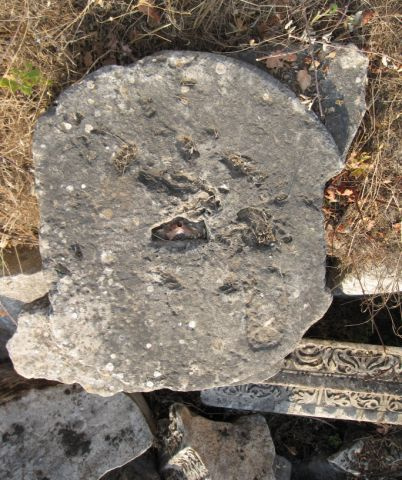
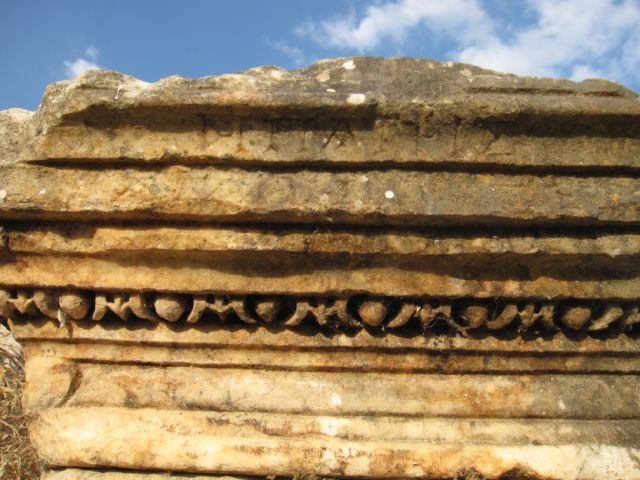
The upper element is elegantly moulded and bears the first two lines of the inscription. On its top surface is a raised circular cushion on which once probably rested a bronze statue. There are various cuttings and the impression of a left foot around a central lewis hole. Both sides of the circular cushion have been cut back in a linear fashion so as to fit it into the basin wall.
PROVENANCE AND CURRENT LOCATION
Excavated in 1977 in the wall of a basin placed directly in front of the Agora Gate. The base itself is aligned with the centre of the Gate. In front of it was found a seated statue of a bare-chested man wearing a himation (Smith et al, Aphrodisias, no. ).
HONORAND AND DATE
The honorand, Titus Oppius Aelianus Asclepiodotus, held the office of governor of the joint province of Caria and Phrygia. This province was created in the 250s and dissolved between 301 and 305. Thus, this inscription belongs securely after 250 and before c. 310.
It perhaps can be dated even more precisely to after 284. A milestone from Phrygia names an Asclepiodotus who was governor between September 282 and July 283 (SEG 41.1101). This man might plausibly be the same governor as honoured at Aphrodisias notwithstanding that milestone names him as an equestrian, a vir perfectissimus, as opposed to a clarissimus in the Aphrodisian inscription. One might imagine that Asclepiodotus was adlected to the senate and became a clarissimus when he became the corrector and proconsul of Asia. The unusual joint appointment of corrector and proconsul as well as the adlection might well suit a moment re-organization under Diocletian.
RE-USE
It is unclear how many times this base has been re-used. The lack of finished moulding on the viewer’s right side suggests that that side was originally a back side. Thus possibly the inscription for Asclepiodotus which is oddly fit within the panel was not its first use.
Moreover, the final use in the basin in front of the Agora Gate post-dates Asclepiodotus, by approximately 150 years. The statue in the pose of an intellectual which was found with the base would be inappropriate for governor. The central location of the statue in the basin in line with the centre axis of the Gate makes it better understood as a deliberate part of the refurbishment of the gate. This would also disassociate the crowning upper element from the shaft and thus, one would not be in the difficult position of explaining why the patris and Tiberius Claudius Marcianus are both in the nominative case.
Cite: Last Statues of Antiquity, LSA-195 (J. Lenaghan).