
LSA-1951
Architrave (?) with inscription for statue of Galerius, emperor. Thugga (Africa Proconsularis). 295
Record details
Photographs
Inscription
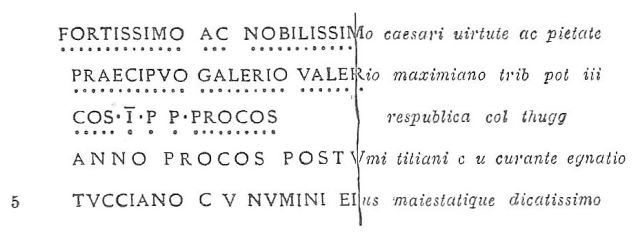
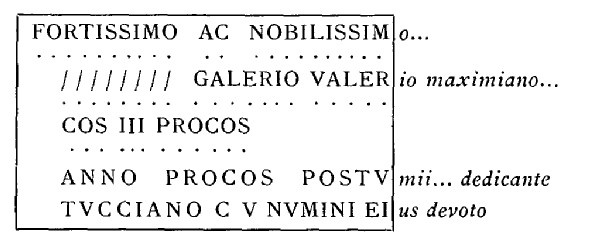
[[Fortissimo ac nobilissim[o Caesari, virtute etiam ac pietate]]] / [[[praecipuo, C(aio) ?] Galerio Valer[io Maximiano, trib(unicia) pot(estate) III]]], / [[co(n)s(uli) I, [p(atri) p(atriae)], proco(n)s(uli), [res publica col(oniae) Thugg(ae)]]], / anno proco(n)s(ulatu) Postu[mi Titiani c(larissimi) v(iri), curante] / Tucciano c(larissimo) v(iro), numini ei[us maiestatique dicatissimo ?].
Inscription translation
To the most powerful and most noble Caesar, outstanding in virtue and piety, Caius Galerius Valerius Maximianus, holding tribunician power three times, consul for the first time, father of the fatherland, proconsul. The community (res publica) of the colony of Thugga [set this up] in the year of the governorship of Postumus Titianus, of clarissimus rank; with Egnatius Tuccianus, [also] of clarissimus rank, taking charge, most devoted to his divine spirit and majesty.
.
Bibliography
- Cagnat, R., Merlin, A., Inscriptions latines d'Afrique, Paris, 1923, no. 532 a
- Lepelley, C., Les cités de l'Afrique romaine au Bas-Empire, t. 2, Notices d'histoire municipale, Paris 1981, p. 219, n. 7
- Lepelley, C., Les cités de l'Afrique romaine au Bas-Empire, t. 2, Notices d'histoire municipale, Paris 1981, VIII, no. 26567
Discussion
INSCRIPTION
The beginnings of five lines of inscription survive:
[[Fortissimo ac nobilissim[o Caesari, virtute etiam ac pietate]]] / [[[praecipuo, C(aio) ?] Galerio Valer[io Maximiano, trib(unicia) pot(estate) III]]], / [[co(n)s(uli) I, [p(atri) p(atriae)], proco(n)s(uli), [res publica col(oniae) Thugg(ae)]]], / anno proco(n)s(ulatu) Postu[mi Titiani c(larissimi) v(iri), curante] / Tucciano c(larissimo) v(iro), numini ei[us maiestatique dicatissimo ?]
'To the most powerful and most noble Caesar, outstanding in virtue and piety, Caius Galerius Valerius Maximianus, holding tribunician power three times, consul for the first time, father of the fatherland, proconsul. The commonwealth (res publica) of the colony of Thugga [set this up] in the year of the governorship of Postumus Titianus, of clarissimus rank; with Egnatius Tuccianus, [also] of clarissimus rank, taking charge, most devoted to his divine spirit and majesty.'
The inscription is in large capitals, 12-11 cm high.
The first three lines of the inscription have been deliberately erased, but were apparently still partially legible when recorded. The wording of our inscription is so close to that of another, more complete, dedication from Thugga (to Constantius I, LSA-1170), for there to be reasonable confidence in the completions suggested here.
DESCRIPTION (from Poinssot and the CIL)
Left-hand block of an inscription set out over two blocks (compare LSA-1170): H 85, W. 142 cm, depth unrecorded.
PROVENANCE AND CURRENT LOCATION
Found to the west of the Capitolium. There is no recent published record of its location.
HONORAND, AWARDER AND DATE
The honorand, Galerius, was Caesar from 293 to 305.
The awarder was the city, as usual for imperial statues in Africa. Egnatius Tuccianus, who was responsible for setting up the dedication, was probably curator (chief magistrate) of Thugga (PLRE I, 924, Tuccianus).
Galerius' first consulship was in the year 295, while the governorship of Titus Flavius Postumius Titianus (PLRE I, 919-20, Titianus 9), which is also mentioned, began in July 295. Our inscription can therefore be dated between July and December 295.
FURTHER DISCUSSION
The erasure of Galerius' name could have been done during Maxentius' rule over Africa in 310-12, but might also have been the work of later Christians, who elsewhere in Africa are known to have destroyed the inscriptions of notorious persecutors.
Our inscription, and another in Thugga dedicated to Constantius I (LSA-1170), are of the same year, and have the same formula. C. Poinssot and later C. Lepelley suggested they were part of a single monument located on the forum, southwest of the Capitolium, with four statues of the Tetrarchs above (See Poinssot, 1983, 39, and Lepelley, 1981, 219). Demaison and Maurin, however, argue that the measurements and layout of these two inscriptions are dissimilar, and favour a hypothesis that the two inscriptions derive from two differents monuments. As both inscriptions were found close to a large substructure to the southwest of the Capitolium, the hypothesis of Poinssot and Lepelley is the most attractive.
Discussion references
- Khanoussi, M. and L. Maurin (eds.), Dougga, fragments d'histoire : choix d'inscriptions latines éditées, traduites et commentées (1er-IVe siècles), Bordeaux 2000, p. 50-51, no. 21
Cite: Last Statues of Antiquity, LSA-1951 (Gabriel de Bruyn).