
LSA-1952
Base for statue of Constantine I, emperor. Tubernuc (Africa Proconsularis). 312-337
Record details
Photographs
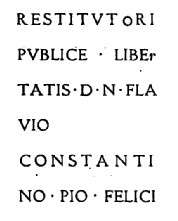
Inscription
Restitutori / public(a)e libe[r]/tatis, d(omino) n(ostro) Fla/vio / (5) Constanti/no, pio, felici / [Augusto ----
Inscription translation
To the restorer of public freedom, our lord Flavius Constantinus, pious, fortunate Augustus ...
Bibliography
- Lepelley, C., Les cités de l'Afrique romaine au Bas-Empire, t. 2, Notices d'histoire municipale, Paris 1981, p. 227, n. 1
- Merlin, A., Inscriptions latines de la Tunisie, Paris, 1944, no. 813
Discussion
INSCRIPTION
In six surviving lines:
Restitutori / public(a)e libe[r]/tatis, d(omino) n(ostro) Fla/vio / (5) Constanti/no, pio, felici / [Augusto ----
'To the restorer of public freedom, our lord Flavius Constantinus, pious, fortunate Augustus ...'
Letter height : 7 - 5 cm
DESCRIPTION (from Poinssot and Lantier, 1925)
Statue base : H 137, W 55, depth unrecorded. On the upper face, Poinssot and Lantier observed holes designed to fix the feet of the statue ('A la partie supérieure, trous d'encastrement ayant servi à fixer les pieds de la statue'). The bottom of the base is certainly missing, since the inscription will have concluded at least with 'Augusto', and, perhaps, with the details of the awarder.
PROVENANCE AND CURRENT LOCATION
Found in the excavations of the steps of the Capitolium. There is no recent published record of its location.
HONORAND, AWARDER AND DATE
The honorand, Constantine I, was Augustus from 307 to 337.
Although the name of the awarder is lost, like almost all late antique imperial statues in Africa, this monument was probably ordered by the city.
The formula 'restitutori publicae libertatis' is certainly an allusion to Constantine's victory over Maxentius in 312, which provides a terminus post quem for our dedication.
Discussion references
- Compte-rendus des séances de la Commission de l'Afrique du Nord, Bulletin archéologique du Comité des Travaux Historiques et Scientifiques, Paris, 1925, p. CCXLIX
Cite: Last Statues of Antiquity, LSA-1952 (Gabriel de Bruyn).