
LSA-1953
Base for statue of Constantius I, emperor. Ureu (Africa Proconsularis). 305-306
Record details
Photographs
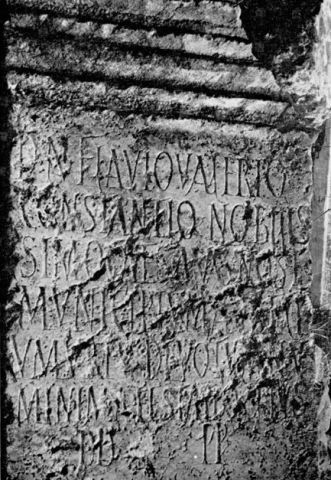
Inscription
D(omino) n(ostro) Flavio Valerio / Constantio, nobilis/simo Caes(ari), Aug(usto) nost(ro), / (4) municipium Aureli/um Ureu, devotum nu/mini maiestatiq(ue) eius, / d(ecreto) d(ecurionum), p(ecunia) p(ublica).
Inscription translation
To our lord Flavius Valerius Constantius, most noble Caesar, our Augustus. The Aurelian city (municipium) of Ureu, devoted to his divine spirit and majesty, [set this up] by decree of the councillors, with public funds.
Bibliography
- L'Année épigraphique, Paris, 1974, no. 692
- Lepelley, C., Les cités de l'Afrique romaine au Bas-Empire, t. 2, Notices d'histoire municipale, Paris 1981, p. 238, n. 4
Discussion
INSCRIPTION
In seven lines:
D(omino) n(ostro) Flavio Valerio / Constantio, nobilis/simo Caes(ari), Aug(usto) nost(ro), / (4) municipium Aureli/um Ureu, devotum nu/mini maiestatiq(ue) eius, / d(ecreto) d(ecurionum), p(ecunia) p(ublica).
'To our lord Flavius Valerius Constantius, most noble Caesar, our Augustus. The Aurelian city (municipium) of Ureu, devoted to his divine spirit and majesty, [set this up] by decree of the councillors, with public funds.'
Letter height : 6 cm
DESCRIPTION (from Beschaouch)
Base with plinth and crown: H 141, W 97, D 48 cm.
PROVENANCE AND CURRENT LOCATION
Found during clandestine excavations, re-used in the forum area. The base was first published in 1974 by Beschaouch. There is no record of its present location, but it probably remains where it was found.
HONORAND, AWARDER AND DATE
The honorand, Constantius I, was Augustus from 305 to 306.
The awarder was the city, as usual for imperial statues in Africa. The designation of Ureu as 'Aurelian' is because it was given municipal (municipium) status under Marcus Aurelius (161-180).
FURTHER DISCUSSION
In our inscription, Constantius is designated both Caesar and Augustus. This could be due to confusion over the new tetrarchic system created by Diocletian in 293 and experiencing its first change in 305, with the substitution of Diocletian and Maximian, the retiring Augusti, by their Caesars, Galerius and Constantius.
The text appears to draw attention to the fact that Constantius was directly in charge of Africa ('our Augustus, Augusto nostro', line 3). The city may have wanted to emphasise the status of their own Augustus, perhaps among a group of statues to all the tetrarchs.
Discussion references
- Beschaouch, A., "La découverte de trois cités en Afrique proconsulaire (Tunisie) : Alma, Vrev et Asadi. Une contribution à l'étude de la politique municipale de l'Empire romain", Comptes-rendus de l'Académie des Inscriptions et Belles-lettres, Paris, 1974, p. 223-227, fig. 3
Cite: Last Statues of Antiquity, LSA-1953 (Gabriel de Bruyn).