
LSA-1956
Base for statue of Constantine I, emperor. Utica (Africa Proconsularis). 324
Record details
Photographs
Inscription
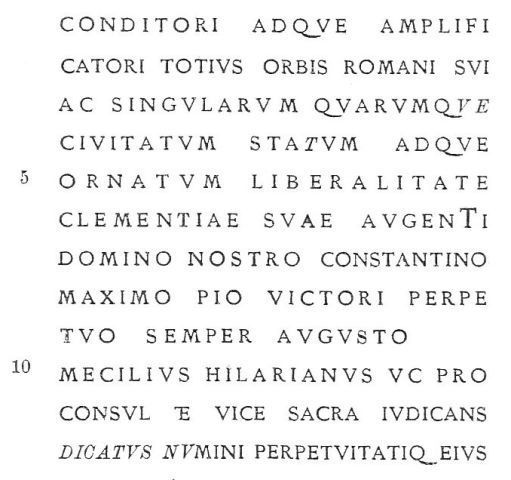
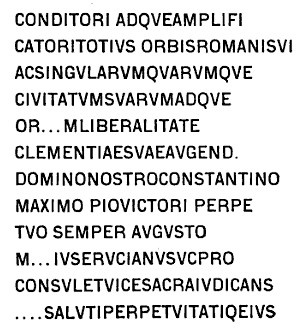
Conditori adque amplifi/catori totius orbis Romani sui, / ac singularum quarumque / civitatum statum adque / (5) ornatum liberalitate / clementiae suae augenti, / domino nostro Constantino, / maximo, pio, victori, perpe/tuo semper Augusto, / Mecilius Hilarianus, v(ir) c(larissimus), proconsul / (11) et vice sacra iudicans, / dicatus numini perpetuitatiq(ue) eius.
Inscription translation
To the founder and increaser of his whole Roman world, and enhancer, through the generosity of his kindness, of the condition and adornment of each and every city, our lord Constantinus, the greatest, pious, victor, perpetual [and] forever Augustus. Mecilius Hilarianus, of clarissimus rank, governor (proconsul) and judge in place of the emperor, devoted to his divine spirit and perpetuity, [set this up].
Bibliography
- Corpus Inscriptionum Latinarum; , VIII, no. 1179
- Corpus Inscriptionum Latinarum; , VIII, no. 14309
- Lepelley, C., Les cités de l'Afrique romaine au Bas-Empire, t. 2, Notices d'histoire municipale, Paris 1981, p. 243, n. 13-4
Discussion
INSCRIPTION
In twelve lines:
Conditori adque amplifi/catori totius orbis Romani sui, / ac singularum quarumque / civitatum statum adque / (5) ornatum liberalitate / clementiae suae augenti, / domino nostro Constantino, / maximo, pio, victori, perpe/tuo semper Augusto, / Mecilius Hilarianus, v(ir) c(larissimus), proconsul / (11) et vice sacra iudicans, / dicatus numini perpetuitatiq(ue) eius.
'To the founder and increaser of his whole Roman world, and enhancer, through the generosity of his kindness, of the condition and adornment of each and every city, our lord Constantinus, the greatest, pious, victor, perpetual [and] forever Augustus. Mecilius Hilarianus, of clarissimus rank, governor (proconsul) and judge in place of the emperor, devoted to his divine spirit and perpetuity, [set this up].'
DESCRIPTION (from CIL)
White marble plaque which seems to have been fixed by four bronze nails to a wall or pedestal ('Paraît avoir été contenu au moyen de quatre clous de bronze contre un mur ou un piédestal'). The formula, with the honorand's name in the dative and the awarder's name in the nominative, is certainly for a statue.
PROVENANCE AND CURRENT LOCATION
There is no published record of its precise findspot or present location.
HONORAND, AWARDER AND DATE
The honorand, Constantine I, was Augustus from 306 to 337.
The awarder, Mecilius Hilarianus (PLRE I, 433, Hilarianus ) is attested as governor of Africa Proconsularis in July 324.
In 324 Constantine replaced invictus, which has pagan connotations, with victor, which appears here (Lassère, 2005, 607).
FURTHER DISCUSSION
Lepelley plausibly suggests that this inscription, with its reference to imperial generosity to cities, commemorated specific imperial largesse to Utica.
Discussion references
- Lassère, J.-M., Manuel d'épigraphie romaine, Paris, 2005, p. 607
Cite: Last Statues of Antiquity, LSA-1956 (Gabriel de Bruyn).