
LSA-1957
Base for statue of Constantine I, emperor. Vina (Africa Proconsularis). 306-308
Record details
Photographs
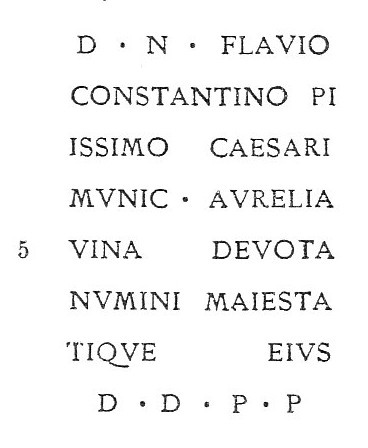
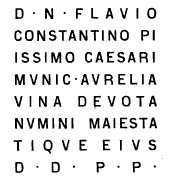
Inscription
D(omino) n(ostro) Fl(avio) Valerio / Constantino, pi/issimo Caesari, / munic(ipium) Aurelia / (5) Vina, devota (sic) / numini maiesta/tique eius, / d(ecreto) d(ecurionum), p(ecunia) p(ublica).
Inscription translation
To our lord Flavius Valerius Constantinus, the most pious Caesar; the Aurelian city (municipium) of Vina, devoted to his divine spirit and majesty, [set this up] by decree of the councillors, with public funds
Bibliography
- Corpus Inscriptionum Latinarum; , VIII, no. 12439
- Corpus Inscriptionum Latinarum; , VIII, no. 961
- Lepelley, C., Les cités de l'Afrique romaine au Bas-Empire, t. 2, Notices d'histoire municipale, Paris 1981, p. 236, n. 5
Discussion
INSCRIPTION
In eight lines:
D(omino) n(ostro) Fl(avio) Valerio / Constantino, pi/issimo Caesari, / munic(ipium) Aurelia / (5) Vina, devota (sic) / numini maiesta/tique eius, / d(ecreto) d(ecurionum), p(ecunia) p(ublica).
'To our lord Flavius Valerius Constantinus, the most pious Caesar; the Aurelian city (municipium) of Vina, devoted to his divine spirit and majesty, [set this up] by decree of the councillors, with public funds.'
Letter height : 5 cm
DESCRIPTION
There are no published descriptions or measurements of this base, and no published image.
PROVENANCE AND CURRENT LOCATION
There is no published record of its original findspot or present location. We only know that our base was found closeby another base that was illegible.
HONORAND, AWARDER AND DATE
The honorand, Constantine I, was Augustus from 306 to 337.
The awarder was the city, as usual for imperial statues in Africa.
Although Constantine was proclaimed Augustus in York in 306, this claim was not universally recognized until 310. Before 310, outside his own areas of control, he was generally recognized only as a Caesar (Kienast 1996, 298-9). We agree with Lepelley, that the terminus post quem for our base is the recognition of Constantine as Caesar by Galerius in 306, and the terminus ante quem the usurpation of Domitius Alexander in 308. After this, Constantine would have been honoured as an Augustus in Africa, since Domitius Alexander recognized him as such. The most likely date for our base is 306-7, during the reign of Severus as Augustus (and effective ruler of Africa). Constantine served officially as Severus' Caesar (junior emperor), a circumstance that might well have led to a dedication to him in Africa.
FURTHER DISCUSSION
Our base must have been part of a group, since, until 312, Constantine was only ever a junior emperor in Africa. It is possible that the unreadable base found with it was dedicated to his colleague as Augustus; if so, the most likely candidate is Severus.
Discussion references
- Kienast, D., Römische Kaisertabelle : Grundzüge einer römischen Kaiserchronologie, Darmstadt, 1996, p. 298-299
Cite: Last Statues of Antiquity, LSA-1957 (Gabriel de Bruyn).