
LSA-197
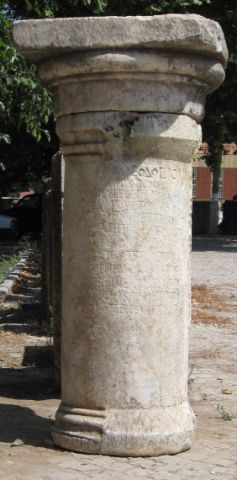
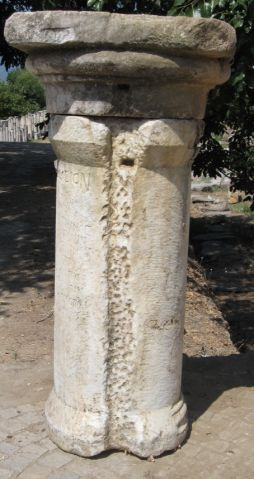
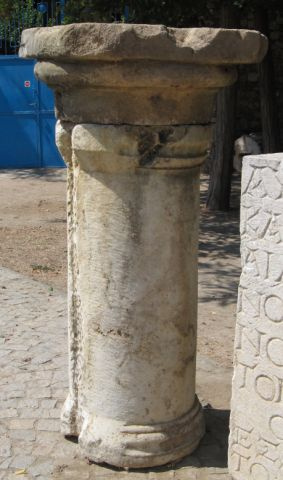
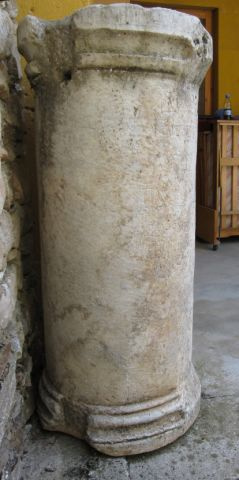
Columnar base for statue of Julian, emperor, later emended to Theodosius, emperor. Aphrodisias (Caria). Later fourth century.
Record details
Photographs
Inscription
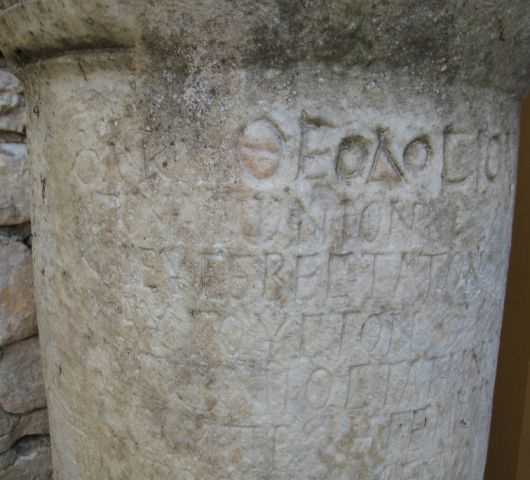
Ἀγαθῆι Τύχηι· / Φλ(άουιον) Κλ(αύδιον) [Ἰουλιανὸν] Θεοδόσιον / v. τὸν αἰώνιον / καὶ εὐσεβέστατον /(5) v. Αὔγουστον / Ἀντώνιος Τατιανὸς / v. ὁ λαμπρ(ότατος) ἡγεμὼν / πᾶν τὸ ὁρώμενον / ἔργον τοῦ τετραστώου /(10) v. ἐκ θεμελίων καὶ τὸν περικειμένον σύμπαν/τα κόσμον τῇ μητροπόλι / v. κατασκευάσας. leaf
Inscription translation
To Good Fortune. Antonius Tatianus, clarissimus praeses, having built all the work of the tetrastoon that can be seen from the foundations, and all the surrounding decoration, for the metropolis, (set up this statue) of Flavius Claudius Julianus (later emended to Theodosius), the eternal and most pious Augustus.
(Trans: C. Roueché)
Bibliography
- Roueché, C., Aphrodisias in Late Antiquity (Journal of Roman Studies Monograph 5), London 1989, no. 20
Discussion
INSCRIPTION:
In twelve lines:
Ἀγαθῆι Τύχηι· / Φλ(άουιον) Κλ(αύδιον) [Ἰουλιανὸν] Θεοδόσιον / v. τὸν αἰώνιον / καὶ εὐσεβέστατον /(5) v. Αὔγουστον / Ἀντώνιος Τατιανὸς / v. ὁ λαμπρ(ότατος) ἡγεμὼν / πᾶν τὸ ὁρώμενον / ἔργον τοῦ τετραστώου /(10) v. ἐκ θεμελίων καὶ τὸν
περικειμένον σύμπαν/τα κόσμον τῇ μητροπόλι / v. κατασκευάσας. leaf
'To Good Fortune. Antonius Tatianus, clarissimus praeses, having built all the work of the tetrastoon that can be seen from the foundations, and all the surrounding decoration, for the metropolis, (set up this statue) of Flavius Claudius Julianus (later emended to Theodosius), the eternal and most pious Augustus.' (Trans: C. Roueché)
Letter height 2.5 - 5 cm.
DESCRIPTION
Columnar base with separately-worked upper and lower element. H (of shaft): 117, Diam (of shaft): 53. H (of lower element): 25 , W: 68, D: 68 cm. Diam (of base): 54 cm. H (of upper element): 30, W: 68, D: 68 cm. Diam (of capital): 50 cm.
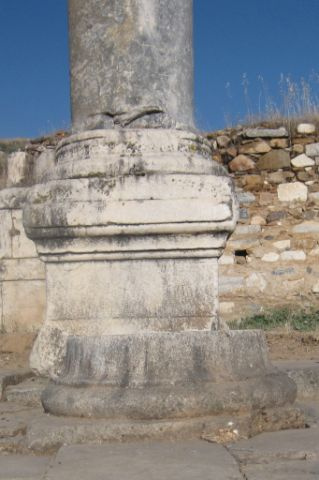
Upper element. This is a re-used late column base. On the sides of the necking/initial part of the shaft are two cut-back areas. Each of these preserves a cutting for the head of a clamp directly under the necking ring/band. These align with the clamp cuttings on the sides of the columnar shaft.
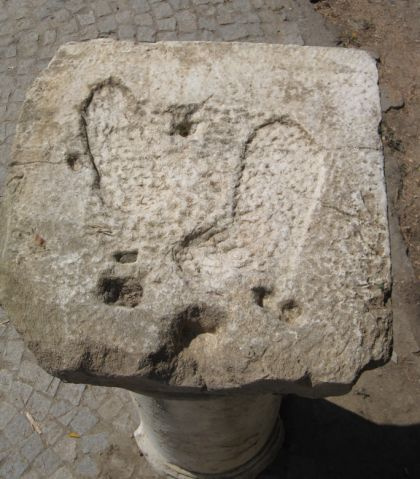
On its top surface it has cuttings for a bronze statue. The area corresponding to the bronze statue is roughly picked and shallow; the feet are set deeper in this cutting. The left foot is forward. The right foot is withdrawn and has a shallow rectangular area on the inside of the inner ankle which is as deep as the foot, probably where drapery touched the plinth
There are six cuttings which appear roughly in pairs and which seem to correspond to the feet. Within the shallow picked area between on the inside of the instep of the left foot is one cutting (1). On the outside of the middle of the left foot is another cutting (2). Behind each heel are two cuttings (total of four) (3-6). These are just outside the shallow picked area. The larger cutting behind the right foot preserves some of the lead casing and iron.
A seventh and significant cutting is placed approximately at the centre of the back edge. This seems to belong to a different statue.
Column shaft. This has been re-used. Careful mouldings, above and below, have been worked from the centre of the current inscription around the proper right side. The current proper right side was the original front of this shaft. Its use as a statue base for Julian and Theodosius are second and third uses.
The shaft has been placed probably in a screen in its second use. On the proper right side the mouldings, upper and lower, have been cut through for a width of 10 cm. In this cutting 12 cm from the top is a cutting for a clamp (which corresponds to that on the upper element). On the proper left side of the shaft is a similar cutting 10 cm broad which, however, runs the entire height of the base. Eleven cm down, below the level of the moulding, is a cutting for the clamp (which corresponds to that on the upper element).
Lower element. This is a re-used column base. It features a low base,a torus, two necking rings, and traces of flutes on the column.
PROVENANCE AND CURRENT LOCATION
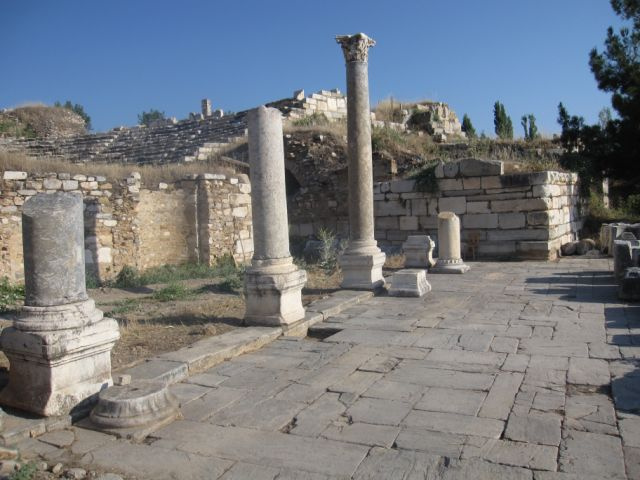
The lower element remains in situ in front of the fourth column (from the north) in the Tetrastoon. It is sunk below the pavement which even carefully follows its broken front proper left corner.
The upper moulded element was found in 1976 in the dismantling of the Byzantine wall behind the northern portion of the stage building. The clamp cuttings in the sides of this upper element correspond exactly to those of the shaft.
The statue base was removed from the Byzantine wall behind the north part of the the theatre stage building late in 1977, after the excavation season had ended.
HONORAND, AWARDER AND DATE
The nomenclature of the inscription, notwithstanding the erasure, and the governor, Antonius Tatianus, who erected it, makes clear that the composite base was dedicated to Julian. The date must be between late 361 and 363. The later emendation of the name to Theodosius should be dated either to the reign of Theodosius I, 379-386 or to Theodosius II, 408-450. The rather limited emendation suggests a limited intervention in the entire monument.
All three parts of the base had a previous use. Although the shaft bears no trace of a previous inscription, the mouldings clearly show that the side designed as the front is now used as proper right. The top of the upper element was used for two different statues, one bronze and one marble.
Cite: Last Statues of Antiquity, LSA-197 (J. Lenaghan).